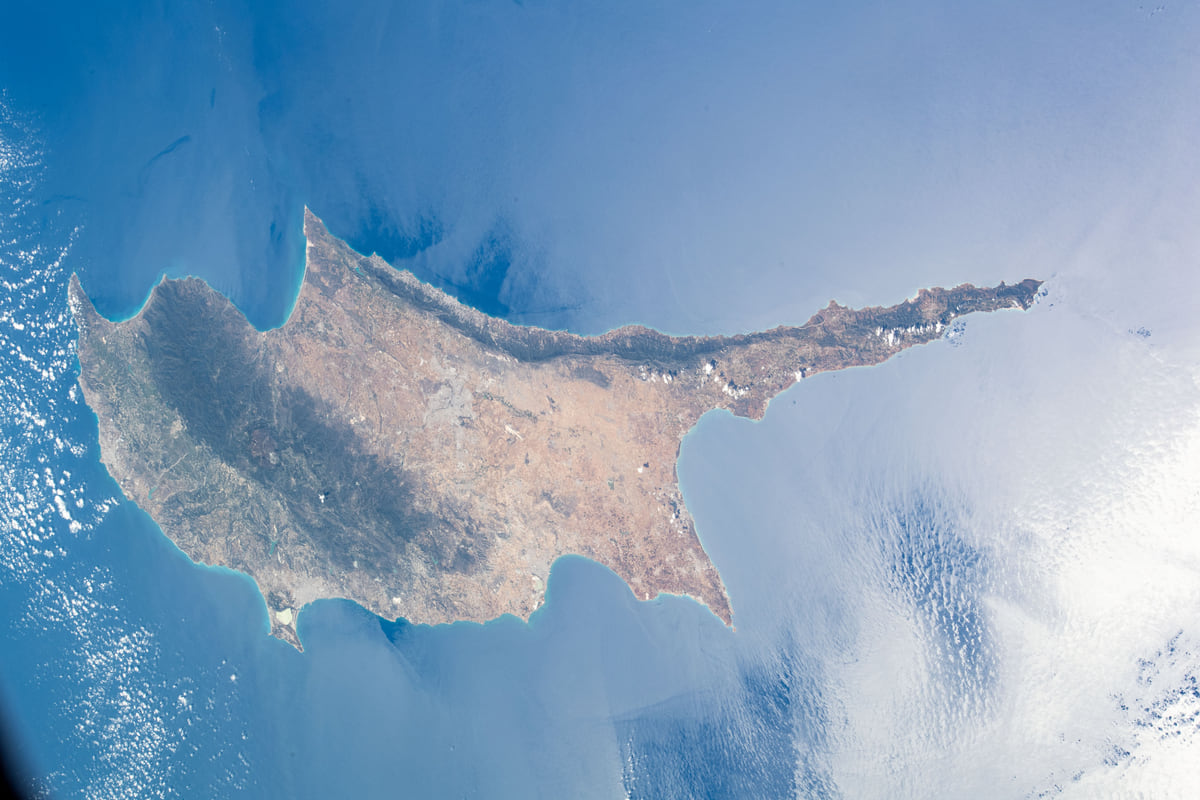
When to visit Cyprus
Cyprus weather, month by month and area by area

Cyprus weather means long, hot, almost rainless summers and mild winters on the coast, with most of the rain between December and February. According to the WMO, Nicosia's average high in July and August reaches 37.5 °C, Larnaca's January high is 17.4 °C with 102 mm of rain, and at Prodromos, in the Troodos, January's high is just 6.9 °C.
Average highs and lows (°C)
| Month | Larnaca | Nicosia | Paphos | Prodromos |
|---|---|---|---|---|
| January | 17.4 / 8.0 | 15.7 / 5.8 | 17.7 / 9.4 | 6.9 / 1.0 |
| February | 17.7 / 7.8 | 16.3 / 6.0 | 17.6 / 9.4 | 7.7 / 1.3 |
| March | 20.2 / 9.1 | 20.1 / 7.8 | 19.5 / 10.3 | 11.8 / 3.8 |
| April | 23.0 / 12.0 | 24.3 / 10.9 | 21.7 / 12.7 | 15.7 / 6.7 |
| May | 26.9 / 16.1 | 29.6 / 15.2 | 24.8 / 15.5 | 20.8 / 10.9 |
| June | 30.8 / 20.1 | 34.3 / 20.0 | 28.2 / 19.2 | 25.4 / 15.2 |
| July | 33.2 / 22.6 | 37.5 / 22.7 | 30.6 / 21.6 | 28.6 / 18.6 |
| August | 33.5 / 23.0 | 37.5 / 22.7 | 31.0 / 22.2 | 28.9 / 18.6 |
| September | 31.4 / 20.5 | 33.6 / 19.5 | 29.4 / 20.4 | 24.7 / 14.9 |
| October | 28.3 / 17.4 | 28.8 / 15.9 | 26.8 / 17.8 | 19.8 / 11.1 |
| November | 23.4 / 12.9 | 22.6 / 10.6 | 23.1 / 13.8 | 13.5 / 6.6 |
| December | 19.2 / 9.8 | 17.8 / 7.3 | 19.6 / 11.0 | 9.3 / 3.3 |
World Meteorological Organization city pages, 2002-2011. Averages of daily highs and lows.
Cyprus weather, in short
Full read: 2 min
- Summers of 33 °C on the coast and 37 °C in Nicosia.
- Mild coastal winters, cold ones in the Troodos.
- Rain falls mainly from December to February.
For me, Cyprus weather comes down to two pieces of advice. In summer, stick to the coast and skip midday walks; in winter, pack a jacket for the mountains and a little patience for January's rain, which tops 100 mm in Larnaca.
What I would book for Cyprus
Before you go
Before you go to Cyprus, this
-
01 Most beautiful
Over 300 days of sun
An official Cypriot government publication puts the average at more than 300 sunny days a year.
the best time to visit Cyprus -
02 My tip
The mountains are different
At Prodromos, in the Troodos, January's high is 6.9 °C and 165 mm of rain falls. A world away from the coast.
Cyprus in winter -
03 Getting there
Nicosia, the extreme one
Being inland, Nicosia has higher summer highs and lower winter lows than the coast.
Cyprus in summer
Before you set off, check this
The weather is the first thing I check before choosing dates, and in Cyprus it varies a lot between the coast, the interior and the mountains. I use World Meteorological Organization data for four stations, Larnaca airport, Nicosia, Paphos airport and Prodromos in the Troodos. If you just want to pick a month, go straight to the best time to visit Cyprus.
Weather on the Cyprus coast
Larnaca and Paphos are much alike. In January highs sit around 17-18 °C and lows around 8-9 °C, and in August they reach 33.5 °C in Larnaca and 31 °C in Paphos, with lows above 22 °C. Paphos, on the west coast, is a touch milder in summer and slightly warmer on winter nights. From June to September there’s barely any rain, and the WMO records zero rainy days in August at Paphos.
When does it rain in Cyprus?
It comes mostly from December to February. January is the wettest month at all four stations, and spring dries out steadily into a summer with hardly a drop. The first proper rain returns in November.
If you are staying the night, see the best hotel deals in Limassol for your dates: the well-placed rooms go fast.
Nicosia and inland, the real heat
Nicosia, in the middle of the island, is the one with the extremes. In July and August the average high climbs to 37.5 °C, and in January the low drops to 5.8 °C. It gets less rain than the coast, 65 mm in January against 102 in Larnaca, but May there is wetter than you’d expect, with 38 mm.
The mountains, another climate
Prodromos, in the Troodos, feels like another island. January’s high is 6.9 °C and its low 1 °C, with 165 mm of rain over 15 days, and in August it doesn’t top 28.9 °C. That’s why you can ski on Mount Olympus in winter, as I explain in Cyprus in winter, and why the mountains are the escape from summer heat. With a gap like that, your bag depends on whether you head up, as I set out in packing list for Cyprus.
So you do not lose the morning at the ticket office, browse tickets and tours in Limassol on GetYourGuide.
Rainy days
More useful than millimetres is counting the days with rain. In Larnaca they drop from 12.4 in January to 1.3 in August, and in Paphos from 12.7 to none at all. At Prodromos it rains on more than half of January’s days, 15.3 on average. So a winter trip always needs an indoor plan, and a summer one the opposite, shade and water.
How I’d use these figures
For the beach, June to September, knowing that Cyprus in summer is very hot. For touring the island, spring and autumn. And for the mountains with snow, winter.
For a specific month, start with Cyprus in January, the wettest, or Cyprus in May, the last month of spring, and for the end of the season, Cyprus in autumn.
If you would rather go at your own pace, see the car hire deals in Limassol: the earlier you book, the more cars are left to choose from.
What I don’t give you
The WMO doesn’t publish monthly sunshine hours or mean temperatures, only highs and lows, and its series runs from 2002 to 2011. The only official sunshine figure I’ve found is more than 300 sunny days a year, from a 2024 government publication. For the sea, month by month with NOAA averages, see Cyprus sea temperature.
If you are staying the night, see the best hotel deals in Limassol for your dates: the well-placed rooms go fast.
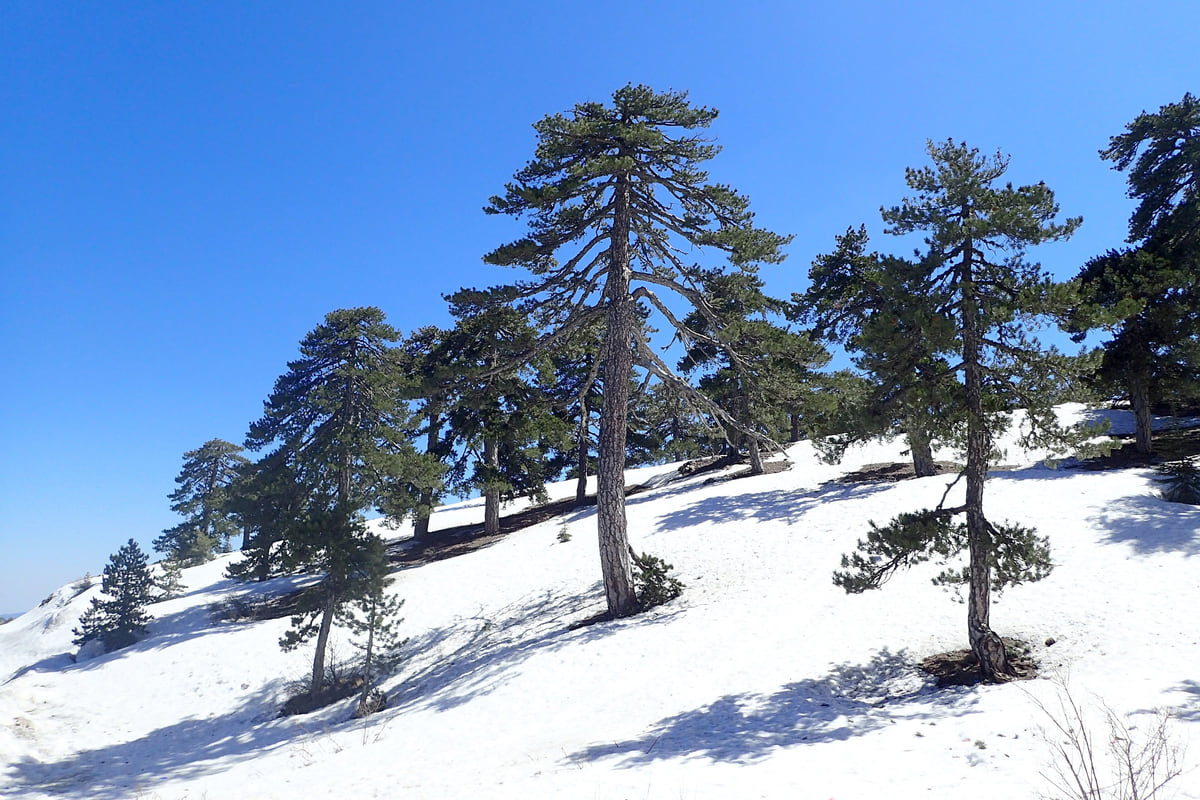
Snow among the black pines of the Troodos Mountains in winter, under a clear blue sky in central Cyprus
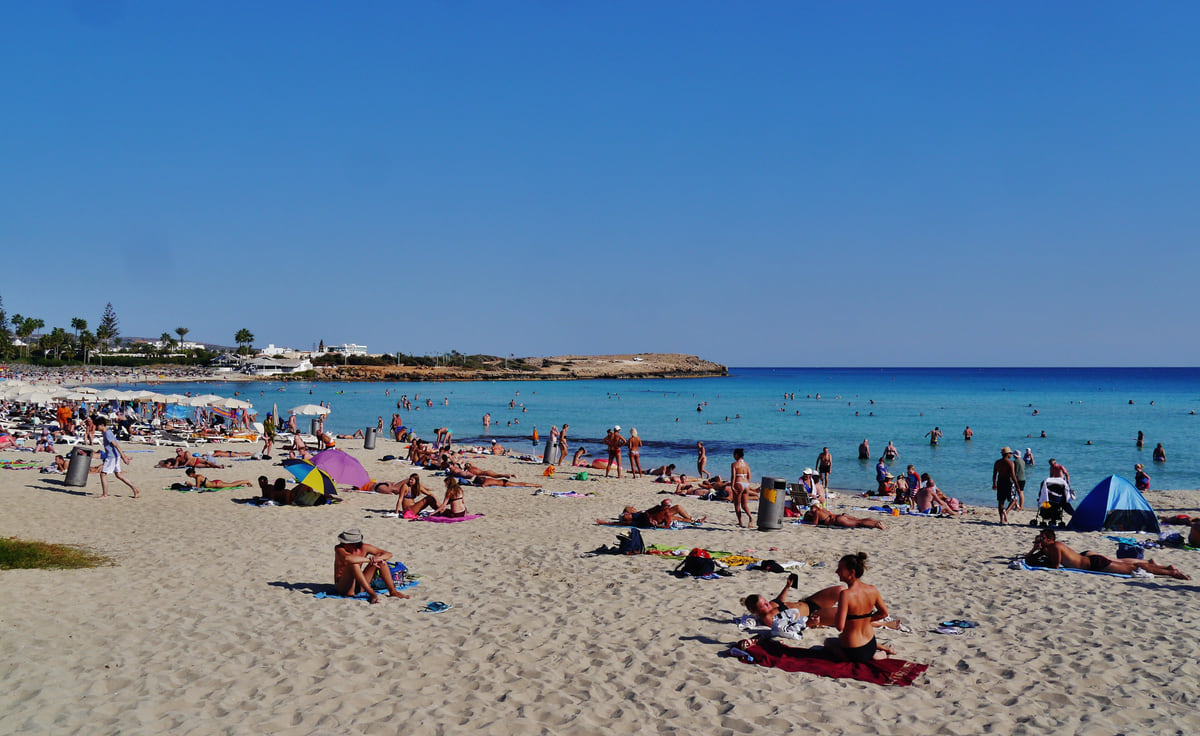
Bathers on the sand at Nissi Beach, Ayia Napa, on a summer day with the sea calm and clear
Test yourself
True or false?
0/3 Pick before you peek.
-
It hardly rains in Paphos in August.
See the answer
True. The WMO gives 0.0 mm and 0.0 rainy days in August at Paphos Airport.
-
Nicosia is cooler than Larnaca in summer.
See the answer
False. It's hotter, 37.5 °C on average in August against 33.5 °C.
-
In the Troodos, January lows are around 1 °C.
See the answer
True. At Prodromos the average January low is 1.0 °C, according to the WMO.
- Nicosia's August high
- 37.5 °C
- Larnaca's January rain
- 102 mm
- Sunny days a year
- 300
0 of 424 Cyprus guides
Your next stamp
- Cyprus in summer
- Cyprus in February
- Cyprus in July
- Sea temperature
- Cyprus in April
- Cyprus in spring
- Cyprus in May
- Cyprus in October
- Almyra Hotel
- Anassa Hotel
- Anastasia Beach
- Aphrodite Hills Resort
- Apostolos Andreas
- Bellapais Abbey
- Cap St Georges
- Church of St Lazarus
- Columbia Beach Resort
- Commandaria
- Coral Beach Hotel
- Cypriot food
- Dome Beach
- Four Seasons Limassol
- Golden Bay
- Grecian Park
- Hilton Nicosia
- Kourion
- Kyrenia Castle
- Larnaca
- Lefkara lace
- Limassol
- Limassol Carnival
- Meze
- Omodos
- Panagia Angeloktisti
- Places to visit
- Selimiye Mosque
- Soli
- St Barnabas Monastery
- Wine routes
- Atlantica Miramare
- Büyük Han
- Cheap eats
- Cyprus in winter
- Finikoudes
- Halloumi
- Kantara Castle
- Kataklysmos
- Limassol Castle
- Narcissos
- Nissi Beach Resort
- Olympic Lagoon Paphos
- Othello Tower
- Sanctuary of Apollo Hylates
- Things to do
- Vouni
- Vouni Palace
- Alion Beach
- Cypriot desserts
- Elias Beach
- Golden Coast
- Koilani
- Kolossi Castle
- Lala Mustafa Pasha Mosque
- Larnaca Castle
- Leonardo Laura Beach
- Limassol old town
- Limassol Wine Festival
- Most beautiful places
- Souvla
- St Hilarion Castle
- Arsos
- Buffavento Castle
- Crystal Springs
- Cypriot wine
- Easter in Cyprus
- Episkopi
- Kition
- Kleftiko
- Limanaki Beach
- Molos promenade
- Pafos Aphrodite Festival
- Pagona
- Prettiest villages
- St Raphael Resort
- Adams Beach
- Akrotiri peninsula
- Alasia Hotel
- Bellapais
- Cyprus in autumn
- Elysium Hotel
- Green Monday
- Independence Day
- Limassol Marina
- Pierides Museum
- Sheftalia
- Sunrise Pearl
- UNESCO World Heritage
- Vasa Koilaniou
- Akrotiri salt lake
- Amathus Beach
- Christmas
- Cyprus in January
- Grecian Bay
- Larnaca Archaeological Museum
- Limassol old port
- Lofou
- Map
- Venus Beach Hotel
- Vrissiana
- Asterias Beach
- Capo Bay
- Cypriot coffee
- Kamares Aqueduct
- Kefalos Beach
- Lania
- Limassol Archaeological Museum
- Parklane
- St Nicholas of the Cats
- Where is Cyprus
- Alexander the Great
- Carob Mill
- Cyprus in March
- Districts
- Hala Sultan Tekke
- Lady's Mile
- Tsokkos Gardens
- Zivania
- Beer
- Cavo Maris
- Germasogeia
- King Evelthon
- Larnaca Salt Lake
- Pissouri
- Towns and villages
- Amathus
- Anogyra
- Athena Beach
- Mackenzie beach
- Population
- Archaeological sites
- Cyprus in June
- King Jason
- Limassol beaches
- Size
- Zenobia wreck
- Aliathon Resort
- Castles in Cyprus
- Governor's Beach
- Languages
- Larnaca beaches
- Annabelle Hotel
- Cyprus in August
- Monasteries in Cyprus
- Name
- Azia Resort
- Cyprus in September
- Museums in Cyprus
- Capital Coast Resort
- Pyla
- Cyprus in November
- Kiti
- Cyprus in December
- Lefkara
- Choirokoitia
- Tochni
- Flag
- How to get there
- Kalavasos
- Krasochoria
- Salamis
- Aphrodite
- Flights
- Karpas Peninsula
- Stavrovouni Monastery
- Kornos
- Larnaca Airport
- Limassol District
- Larnaca district
- Paphos Airport
- Pyrga
- Airport transfers
- Athienou
- Ferry
- Odou
- Cruises
- Kato Drys
- Getting around
- Vavla
- Buses
- Zygi
- Psematismenos
- Taxis
- Agios Irakleidios
- Car hire
- Paphos district
- Driving
- Paphos
- Kato Paphos
- Parking
- Cycling
- Paphos old town (Ktima)
- Paphos Archaeological Park
- Road trip
- Distances
- Tombs of the Kings
- Agia Kyriaki and St Paul's Pillar
- Paphos Byzantine Museum
- Paphos beaches
- Geroskipou
- Cyprus Wine Museum
- Greek or Turkish?
- Peyia (Pegeia)
- Coral Bay
- History
- Sea caves, Peyia
- The division
- Agios Georgios, Peyia
- Political system
- Akamas peninsula
- Religion
- Blue Lagoon, Akamas
- Public holidays
- Baths of Aphrodite
- Time
- Currency and payments
- Lara beach
- Avakas Gorge
- EU and Schengen
- Entry requirements
- Polis Chrysochous
- Facts
- Latchi
- Neo Chorio
- Aphrodite's Rock
- Palaepaphos (Kouklia)
- Paphos Castle
- Paphos Archaeological Museum
- Agia Solomoni Catacomb
- Kathikas
- Drouseia
- Ineia
- Diarizos Valley
- Pano Panagia
- The north
- Where to eat
- Where to stay
- Chrysorrogiatissa Monastery
- Crossing to the north
- Hotels in Ayia Napa
- Agios Neophytos Monastery
- Green Line
- Hotels in Protaras
- British bases
- Hotels in Limassol
- Tala
- Ercan airport
- Hotels in Larnaca
- Lempa
- Hotels in Paphos
- Hotels in the north
- Pano Arodes
- Hotels in Coral Bay
- Kritou Terra
- Kyrenia district
- Hotels in Polis and Latchi
- Kyrenia
- Lysos
- Hotels in Nicosia
- Lapithos
- Pomos
- Cedar Valley
- Hotels in the Troodos
- Ayia Napa
- Best time to visit
- Famagusta district
- Luxury hotels
- North Nicosia
- Agrotourism
- All-inclusive hotels
- Famagusta
- Thalassa Museum
- Adults-only hotels
- Apartments
- Ayia Napa Monastery
- Varosha
- Ayia Napa Sculpture Park
- Family hotels
- Morphou
- Boutique hotels
- Nissi Beach
- Beachfront hotels
- Casinos in Cyprus
- Events
- Makronissos
- Ayia Napa sea caves
- Cheap hotels
- Love Bridge
- Villas
- Ayia Napa beaches
- Campsites
- Cape Greco
- Safety
- Konnos Bay
- Scams and pitfalls
- Cyclops Cave
- Healthcare
- Mobile and roaming
- Free things to do
- What to buy
- With a dog
- Accessible Cyprus
- Plugs
- Tipping
- Protaras
- Tourist information
- Fig Tree Bay
- Packing list
- Prices and budget
- Profitis Ilias Church
- Cyprus on a budget
- Protaras beaches
- Shopping
- Paralimni
- With kids
- Deryneia
- For couples
- Kokkinochoria
- Weddings
- Nightlife
- Sotira
- Liopetri
- Package holidays
- Day trips
- Frenaros
- Nicosia district
- Avgorou
- Boat trips
- Nicosia
- Jeep safari
- Venetian walls
- Famagusta Gate
- Ledra Street
- Laiki Geitonia
- Cyprus Museum
- Byzantine Museum, Nicosia
- St John's Cathedral
- Archbishop's Palace
- 3 days
- Museums in Nicosia
- 5 days
- Chrysaliniotissa
- Leventis Museum
- One week
- 10 days
- Leventis Gallery
- Kornesios house
- Two weeks
- National Struggle Museum
- Ömeriye Mosque
- Faneromeni Church
- Shacolas observatory
- Tamassos
- Idalion
- Machairas Monastery
- Fikardou
- Lythrodontas
- Tilliria
- Kato Pyrgos
- Troodos Mountains
- Mount Olympus
- Troodos Square
- Skiing in Cyprus
- Troodos Geopark
- Painted churches of Troodos
- Kykkos Monastery
- Makarios's tomb
- Trooditissa Monastery
- Platres
- Prodromos
- Foini
- Treis Elies
- Marathasa valley
- Solea valley
- Agios Nikolaos tis Stegis
- Panagia Asinou
- Panagia Podithou
- Archangelos Michael, Pedoulas
- Panagia tou Moutoulla
- Agios Ioannis Lampadistis
- Kalopanayiotis
- Pedoulas
- Moutoullas
- Kakopetria
- Galata
- Evrychou
- Pitsilia
- Stavros tou Agiasmati
- Panagia tou Araka
- Timios Stavros, Pelendri
- Transfiguration church, Palaichori
- Palaichori
- Askas
- Lagoudera
- Polystypos
- Alona
- Agros
- Kyperounta
- Louvaras
- Hiking in Cyprus
- Artemis Trail
- Atalante Trail
- Persephone Trail
- Teisia tis Madaris
- Waterfalls in Cyprus
- Caledonia Waterfall
- Nature parks in Cyprus
- Viewpoints in Cyprus
- Cyprus beaches
- Diving in Cyprus
- Water sports in Cyprus
- Water parks in Cyprus
- Golf in Cyprus
- Mazotos Camel Park
Cyprus weather: questions and answers
What is the weather like in Cyprus?
Mediterranean, with long, hot, dry summers and mild winters on the coast. Rain falls mostly between December and February, according to WMO data.
What is the hottest month in Cyprus?
August, with an average high of 33.5 °C in Larnaca and 37.5 °C in Nicosia. July is almost the same.
When does it rain most in Cyprus?
In January. Larnaca gets 102 mm over 12.4 rainy days and Paphos 91.5 mm over 12.7, according to the WMO.
Is Cyprus cold in winter?
Not much on the coast, where January highs are around 17 °C. In the Troodos it is, with a 6.9 °C high and a 1 °C low at Prodromos.
How many sunny days does Cyprus get?
More than 300 a year on average, according to an official Cypriot government publication from 2024.

Questions about Cyprus? Write to me
If you need something else to finish planning, write to me. I answer myself, no templates.
My email sergiolepone@gmail.com
By
Tourism graduate with a master’s in Tourism Management and Planning from the University of Málaga, who has travelled across Europe. He writes every guide from official sources and his own judgement.
Published on . Updated on . Facts checked on .
Sources
Some links in this guide are affiliate links: if you book through them, the site earns a commission at no extra cost to you. Affiliate disclosure
Photos: NASA (Public domain); Krzysztof Ziarnek, Kenraiz (CC BY-SA 4.0); Zairon (CC BY-SA 4.0), via Wikimedia Commons.