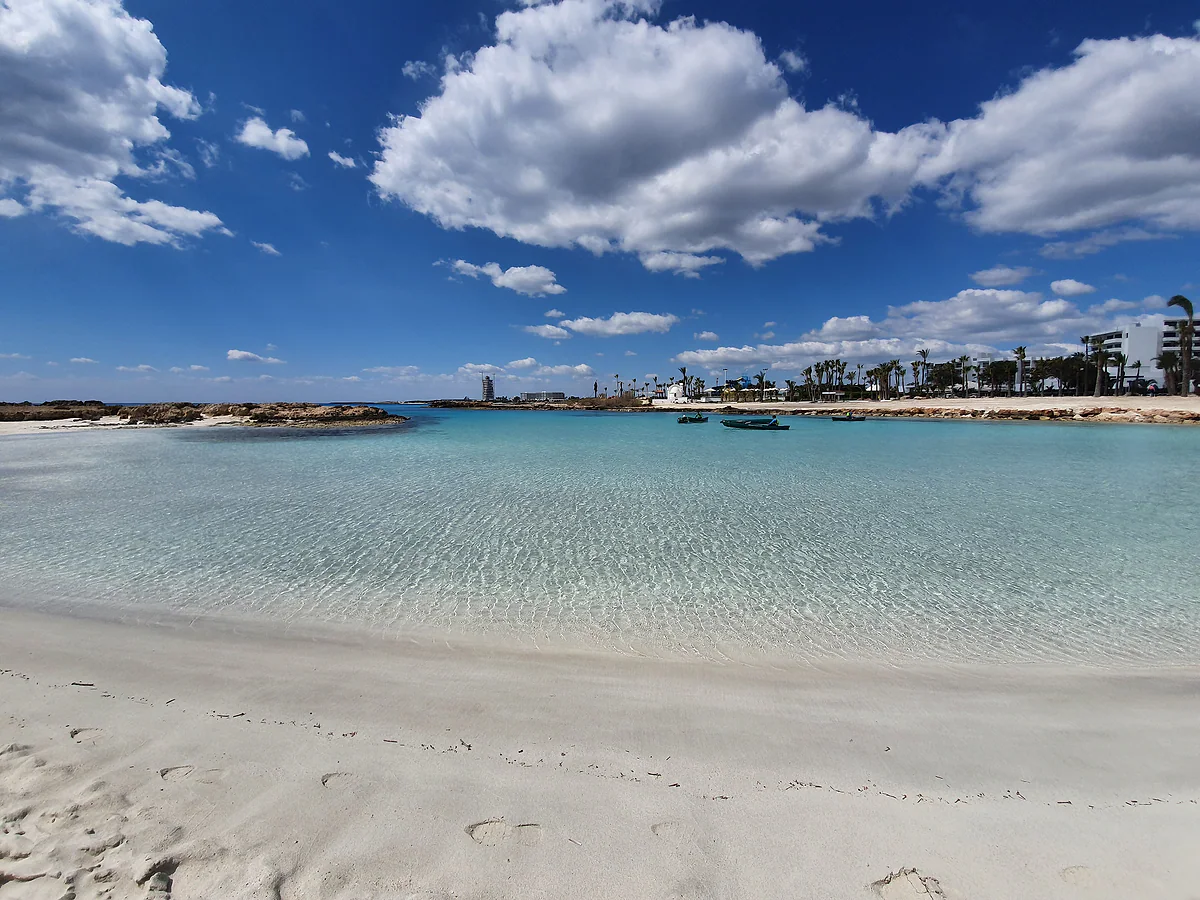
Weather in Cyprus
Cyprus sea temperature, month by month
The sea around Cyprus is coldest in February, at around 16.5 to 16.8 °C on average at the surface, and warmest in August, at around 27 to 28 °C. These are 1991-2020 averages from NOAA's OISST dataset off Larnaca, Limassol, Paphos, Ayia Napa and Polis. From June to October it stays above 23 °C all round the coast.
In 30 seconds
Full read: 3 min
- The sea around Cyprus runs from about 16.5 °C in February to 28 °C in August.
- From June to October it stays above 23 °C on every coast.
- October's sea is almost as warm as June's.
- These are NOAA's 1991-2020 averages.
If swimming matters most, I'd go from late June to early October. October is my favourite, with the sea at around 25 °C, almost as warm as June, and far less heat out of the water.

Before you go
What I would keep in mind
-
01 Most beautiful
October, with June's sea
In October the water sits at around 24.6 to 25.3 °C, close to June, while daytime highs on the coast drop to 27-28 °C.
Cyprus in October -
02 My tip
November is still swimmable
In November the sea is still around 22 °C, barely a degree below the average daytime high in Larnaca and Paphos, according to the WMO.
Cyprus in November -
03 To save money
The sea warms up slowly
In May the water is around 20 °C and in June 23-24 °C. If you're going in May for the prices, expect the sea to be on the fresh side.
Cyprus in May
What I would book
The question I get asked most before a beach holiday is when you can swim without freezing. For Cyprus, the answer fits in a table, as long as you trust the source. Most websites that quote sea temperatures don’t say where the numbers come from, so I went to the raw data from NOAA, the US ocean and weather agency, and read the 1991-2020 averages off five stretches of the Cypriot coast. Rain, heat and the rest are in Cyprus weather.
Where the numbers come from
NOAA’s OISST v2.1 dataset blends satellite, ship and buoy measurements to estimate sea surface temperature on a grid of quarter-degree cells, roughly 25 km across. Its PSL laboratory publishes the average for each month over 1991-2020. I took the sea cell closest to Larnaca, Limassol, Paphos, Ayia Napa and Polis and rounded to one decimal place. Two honest caveats. This is open-sea temperature, not the shoreline, and a sheltered cove can be a touch warmer in summer. And it’s a thirty-year average, not a single year, so a hot summer can run a degree above it.
When is the sea warmest in Cyprus?
August, without question. The average runs from about 27.1 °C off Limassol to about 28.0 °C off Polis. July and September are very close, above 26 °C on every coast. From June to October, five months in a row, the sea stays above 23 °C, which for me is the line for comfortable swimming. If warm water is your priority, that’s the window, and I set it against heat, rain and flight schedules in the best time to visit Cyprus.
Once your dates are set, check which hotels are still free in Ayia Napa before prices climb.
The coldest month, and winter
The low comes in February, with around 16.5 °C off Polis and 16.7 to 16.8 °C elsewhere. January and March are only a few tenths warmer. What’s striking is that in those months the sea is nearly as warm as the air at its daytime peak, which the WMO puts at around 17.7 °C in Larnaca and Paphos in February. For most of us that’s not bathing weather, more a bracing dip for the brave.
October and November, the surprise
Here’s the part of the data I find most useful. In October the sea sits at around 24.6 to 25.3 °C, almost the same as in June, while daytime highs fall to about 28 °C in Larnaca and 27 °C in Paphos. In other words, early-summer water with far less heat. In November the sea is still around 22 °C, barely a degree below the average daytime high. There’s more on that in Cyprus in October, handy for half-term planning.
If you would rather have a local show you round, book a guided tour in Ayia Napa and choose by the reviews.
June or September?
It’s the classic question for anyone with flexible dates, and the data settles it. September’s sea is between 2.4 and 3.1 degrees warmer than June’s on every coast, because it carries the whole summer’s heat. In Larnaca it goes from 23.8 °C in June to 26.9 °C in September, and in Ayia Napa from 24.1 to 27.1 °C. If you’re travelling with children or hate a cold first plunge, I’d pick September.
Which coast has the warmest water?
The differences are tenths of a degree, but there’s a pattern. In summer the west and south-east warm up slightly more, with Polis and Ayia Napa ahead in August, and Limassol the coolest of the five. In winter it flips a little, with Limassol and Paphos holding a few tenths more than Polis. To pick a beach with this in mind, see Cyprus beaches. If diving’s your thing, spring and autumn water changes the experience a lot, as I explain in diving in Cyprus.
A car frees you from timetables: search car hire in Ayia Napa on DiscoverCars and compare companies.
How I’d use it
For a pure beach holiday, late June to early October. To mix beaches with sightseeing without the worst of the heat, late September and October, which also lines up nicely with the October half-term. And be careful with May, because the air is already warm while the sea, at around 20 °C, is still fresh. If you’re flying out over the Easter holidays, pack for sunshine on land rather than long swims, since April water averages only around 18 °C.
Once your dates are set, check which hotels are still free in Ayia Napa before prices climb.
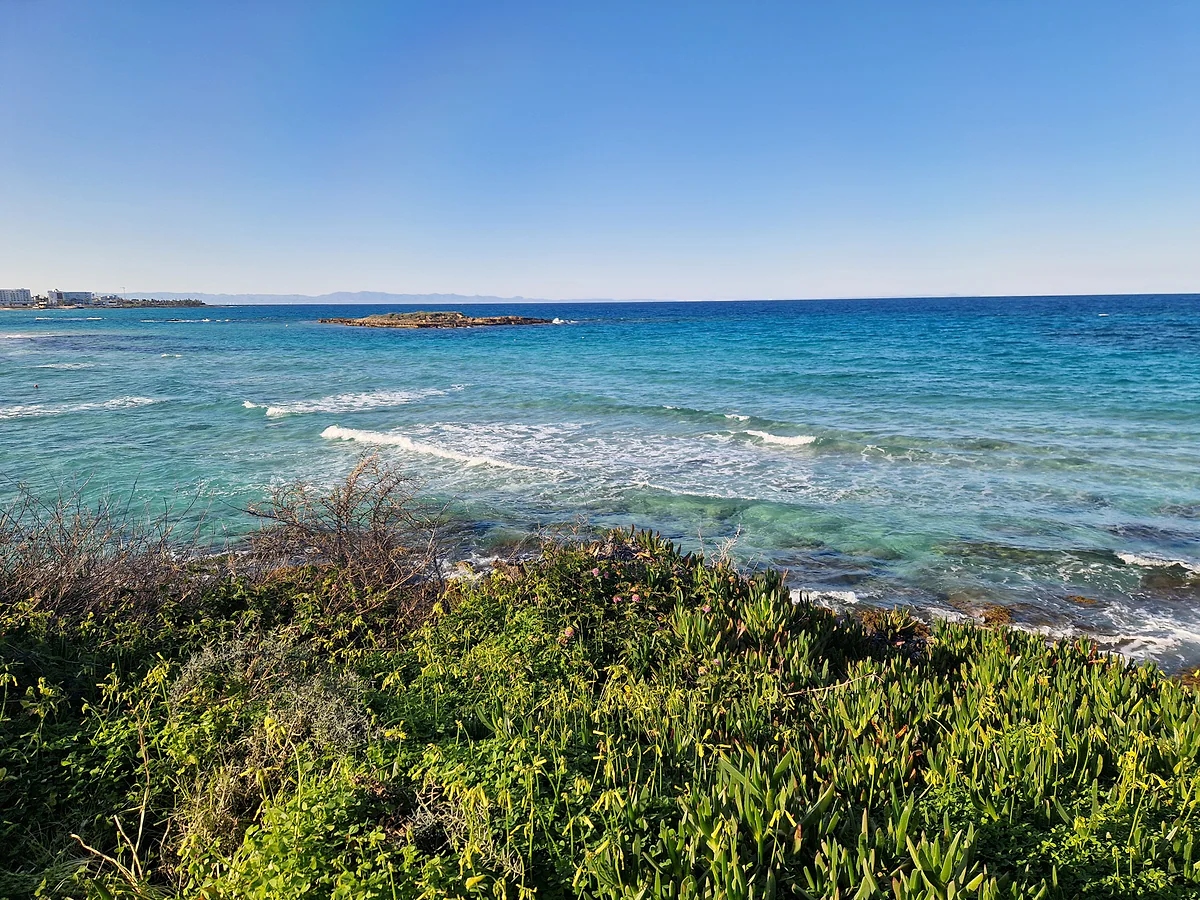
The coast at Protaras by Fig Tree Bay, with turquoise water and a rocky islet offshore, in Cyprus
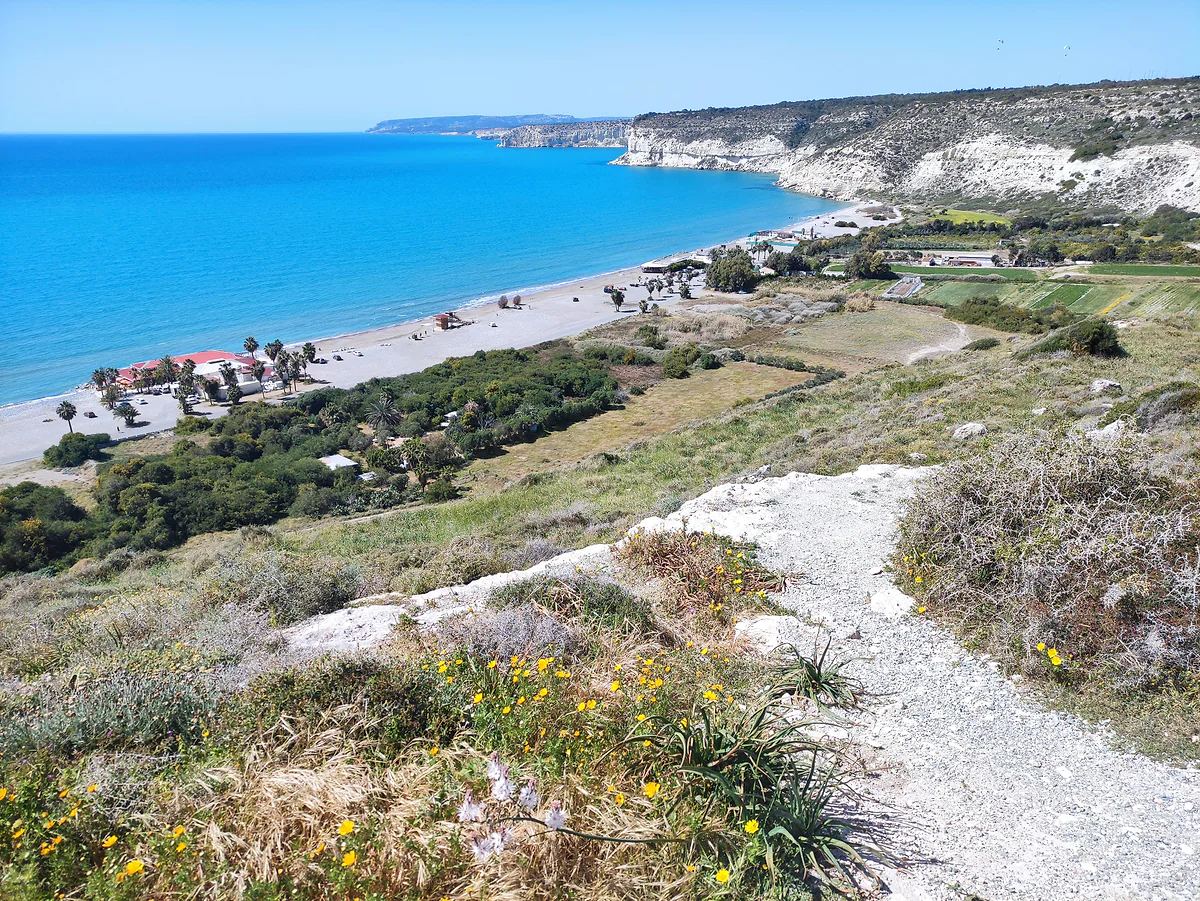
Kourion Beach seen from the white cliff, with its long shore of sand and pebbles and the turquoise sea of the south coast
Average sea surface temperature (°C), 1991-2020
| Month | Larnaca | Limassol | Paphos | Ayia Napa | Polis |
|---|---|---|---|---|---|
| January | 17.2 | 17.5 | 17.4 | 17.2 | 17.1 |
| February | 16.7 | 16.8 | 16.7 | 16.7 | 16.5 |
| March | 17.0 | 17.0 | 16.9 | 17.0 | 16.7 |
| April | 18.1 | 17.9 | 17.9 | 18.2 | 17.9 |
| May | 20.5 | 20.1 | 20.4 | 20.7 | 20.6 |
| June | 23.8 | 23.3 | 23.9 | 24.1 | 24.3 |
| July | 26.4 | 26.1 | 26.8 | 26.7 | 27.2 |
| August | 27.5 | 27.1 | 27.6 | 27.8 | 28.0 |
| September | 26.9 | 26.3 | 26.5 | 27.1 | 26.7 |
| October | 25.2 | 24.8 | 24.7 | 25.3 | 24.6 |
| November | 22.3 | 22.3 | 22.2 | 22.3 | 21.9 |
| December | 19.4 | 19.5 | 19.4 | 19.3 | 19.1 |
NOAA PSL, OISST v2.1 high resolution, long-term monthly mean 1991-2020 (0.25° sea cells off each coast). My own reading and rounding, 4 October 2026.
Sea and air in Larnaca and Paphos
| Month | Sea, Larnaca | Air high, Larnaca | Sea, Paphos | Air high, Paphos |
|---|---|---|---|---|
| February | 16.7 | 17.7 | 16.7 | 17.6 |
| May | 20.5 | 26.9 | 20.4 | 24.8 |
| August | 27.5 | 33.5 | 27.6 | 31.0 |
| October | 25.2 | 28.3 | 24.7 | 26.8 |
| November | 22.3 | 23.4 | 22.2 | 23.1 |
Sea, NOAA OISST 1991-2020; air, WMO average daily maximums, 2002-2011. Different periods, so treat the comparison as a guide.
Test yourself
True or false?
0/3 Pick before you peek.
-
January is the month with the coldest sea in Cyprus.
See the answer
False. It's February, at around 16.5 to 16.8 °C on average; January is slightly milder.
-
In October the sea is almost as warm as in June.
See the answer
True. October averages 24.6-25.3 °C and June 23.3-24.3 °C over 1991-2020.
-
Limassol has the island's warmest sea in August.
See the answer
False. It's the coolest of the five coasts measured in August, at about 27.1 °C; Polis reaches 28.0 °C.
- Low, February off Polis
- 16.5 °C
- High, August off Polis
- 28.0 °C
- Above 23 °C
- 5 months
0 of 421 Cyprus guides
Your next stamp
- Cyprus in summer
- Cyprus in autumn
- Weather
- Cyprus in spring
- Cyprus in February
- Cyprus in January
- Cyprus in August
- Cyprus in October
- Almyra Hotel
- Anassa Hotel
- Anastasia Beach
- Aphrodite Hills Resort
- Apostolos Andreas
- Bellapais Abbey
- Cap St Georges
- Church of St Lazarus
- Columbia Beach Resort
- Commandaria
- Coral Beach Hotel
- Cypriot food
- Dome Beach
- Four Seasons Limassol
- Golden Bay
- Grecian Park
- Hilton Nicosia
- Kourion
- Kyrenia Castle
- Larnaca
- Lefkara lace
- Limassol
- Limassol Carnival
- Meze
- Omodos
- Panagia Angeloktisti
- Places to visit
- Selimiye Mosque
- Soli
- St Barnabas Monastery
- Wine routes
- Atlantica Miramare
- Büyük Han
- Cheap eats
- Cyprus in winter
- Finikoudes
- Halloumi
- Kantara Castle
- Kataklysmos
- Limassol Castle
- Narcissos
- Nissi Beach Resort
- Olympic Lagoon Paphos
- Othello Tower
- Sanctuary of Apollo Hylates
- Things to do
- Vouni
- Vouni Palace
- Alion Beach
- Cypriot desserts
- Elias Beach
- Golden Coast
- Koilani
- Kolossi Castle
- Lala Mustafa Pasha Mosque
- Larnaca Castle
- Leonardo Laura Beach
- Limassol old town
- Limassol Wine Festival
- Most beautiful places
- Souvla
- St Hilarion Castle
- Arsos
- Buffavento Castle
- Crystal Springs
- Cypriot wine
- Easter in Cyprus
- Episkopi
- Kition
- Kleftiko
- Limanaki Beach
- Molos promenade
- Pafos Aphrodite Festival
- Pagona
- Prettiest villages
- St Raphael Resort
- Adams Beach
- Akrotiri peninsula
- Alasia Hotel
- Bellapais
- Elysium Hotel
- Green Monday
- Independence Day
- Limassol Marina
- Pierides Museum
- Sheftalia
- Sunrise Pearl
- UNESCO World Heritage
- Vasa Koilaniou
- Akrotiri salt lake
- Amathus Beach
- Christmas
- Grecian Bay
- Larnaca Archaeological Museum
- Limassol old port
- Lofou
- Map
- Venus Beach Hotel
- Vrissiana
- Asterias Beach
- Capo Bay
- Cypriot coffee
- Kamares Aqueduct
- Kefalos Beach
- Lania
- Limassol Archaeological Museum
- Parklane
- St Nicholas of the Cats
- Where is Cyprus
- Alexander the Great
- Carob Mill
- Cyprus in March
- Districts
- Hala Sultan Tekke
- Lady's Mile
- Tsokkos Gardens
- Zivania
- Beer
- Cavo Maris
- Cyprus in April
- Germasogeia
- King Evelthon
- Larnaca Salt Lake
- Pissouri
- Towns and villages
- Amathus
- Anogyra
- Athena Beach
- Cyprus in May
- Mackenzie beach
- Population
- Archaeological sites
- Cyprus in June
- King Jason
- Limassol beaches
- Size
- Zenobia wreck
- Aliathon Resort
- Castles in Cyprus
- Cyprus in July
- Governor's Beach
- Languages
- Larnaca beaches
- Annabelle Hotel
- Monasteries in Cyprus
- Name
- Azia Resort
- Cyprus in September
- Museums in Cyprus
- Capital Coast Resort
- Pyla
- Cyprus in November
- Kiti
- Cyprus in December
- Lefkara
- Choirokoitia
- Tochni
- Flag
- How to get there
- Kalavasos
- Krasochoria
- Salamis
- Aphrodite
- Flights
- Karpas Peninsula
- Stavrovouni Monastery
- Kornos
- Larnaca Airport
- Limassol District
- Larnaca district
- Paphos Airport
- Pyrga
- Airport transfers
- Athienou
- Ferry
- Odou
- Cruises
- Kato Drys
- Getting around
- Vavla
- Buses
- Zygi
- Taxis
- Agios Irakleidios
- Car hire
- Paphos district
- Driving
- Paphos
- Kato Paphos
- Parking
- Cycling
- Paphos old town (Ktima)
- Paphos Archaeological Park
- Road trip
- Distances
- Tombs of the Kings
- Agia Kyriaki and St Paul's Pillar
- Paphos Byzantine Museum
- Paphos beaches
- Geroskipou
- Cyprus Wine Museum
- Greek or Turkish?
- Peyia (Pegeia)
- Coral Bay
- History
- Sea caves, Peyia
- The division
- Agios Georgios, Peyia
- Political system
- Akamas peninsula
- Religion
- Blue Lagoon, Akamas
- Public holidays
- Baths of Aphrodite
- Time
- Currency and payments
- Lara beach
- Avakas Gorge
- EU and Schengen
- Entry requirements
- Polis Chrysochous
- Facts
- Latchi
- Neo Chorio
- Aphrodite's Rock
- Palaepaphos (Kouklia)
- Paphos Castle
- Paphos Archaeological Museum
- Agia Solomoni Catacomb
- Kathikas
- Drouseia
- Ineia
- Diarizos Valley
- Pano Panagia
- The north
- Where to eat
- Where to stay
- Chrysorrogiatissa Monastery
- Crossing to the north
- Hotels in Ayia Napa
- Agios Neophytos Monastery
- Green Line
- Hotels in Protaras
- British bases
- Hotels in Limassol
- Tala
- Ercan airport
- Hotels in Larnaca
- Lempa
- Hotels in Paphos
- Hotels in the north
- Pano Arodes
- Hotels in Coral Bay
- Kritou Terra
- Kyrenia district
- Hotels in Polis and Latchi
- Kyrenia
- Lysos
- Hotels in Nicosia
- Lapithos
- Pomos
- Cedar Valley
- Hotels in the Troodos
- Ayia Napa
- Best time to visit
- Famagusta district
- Luxury hotels
- North Nicosia
- Agrotourism
- All-inclusive hotels
- Famagusta
- Thalassa Museum
- Adults-only hotels
- Apartments
- Ayia Napa Monastery
- Varosha
- Ayia Napa Sculpture Park
- Family hotels
- Morphou
- Boutique hotels
- Nissi Beach
- Beachfront hotels
- Events
- Makronissos
- Ayia Napa sea caves
- Cheap hotels
- Love Bridge
- Villas
- Ayia Napa beaches
- Campsites
- Cape Greco
- Safety
- Konnos Bay
- Scams and pitfalls
- Cyclops Cave
- Healthcare
- Mobile and roaming
- Free things to do
- What to buy
- With a dog
- Accessible Cyprus
- Plugs
- Tipping
- Protaras
- Tourist information
- Fig Tree Bay
- Packing list
- Prices and budget
- Profitis Ilias Church
- Cyprus on a budget
- Protaras beaches
- Shopping
- Paralimni
- With kids
- Deryneia
- For couples
- Kokkinochoria
- Weddings
- Nightlife
- Sotira
- Liopetri
- Package holidays
- Day trips
- Frenaros
- Nicosia district
- Avgorou
- Boat trips
- Nicosia
- Jeep safari
- Venetian walls
- Famagusta Gate
- Ledra Street
- Laiki Geitonia
- Cyprus Museum
- Byzantine Museum, Nicosia
- St John's Cathedral
- Archbishop's Palace
- 3 days
- Museums in Nicosia
- 5 days
- Chrysaliniotissa
- Leventis Museum
- One week
- 10 days
- Leventis Gallery
- Kornesios house
- Two weeks
- National Struggle Museum
- Ömeriye Mosque
- Faneromeni Church
- Shacolas observatory
- Tamassos
- Idalion
- Machairas Monastery
- Fikardou
- Lythrodontas
- Tilliria
- Kato Pyrgos
- Troodos Mountains
- Mount Olympus
- Troodos Square
- Skiing in Cyprus
- Troodos Geopark
- Painted churches of Troodos
- Kykkos Monastery
- Makarios's tomb
- Trooditissa Monastery
- Platres
- Prodromos
- Foini
- Treis Elies
- Marathasa valley
- Solea valley
- Agios Nikolaos tis Stegis
- Panagia Asinou
- Panagia Podithou
- Archangelos Michael, Pedoulas
- Panagia tou Moutoulla
- Agios Ioannis Lampadistis
- Kalopanayiotis
- Pedoulas
- Moutoullas
- Kakopetria
- Galata
- Evrychou
- Pitsilia
- Stavros tou Agiasmati
- Panagia tou Araka
- Timios Stavros, Pelendri
- Transfiguration church, Palaichori
- Palaichori
- Askas
- Lagoudera
- Polystypos
- Alona
- Agros
- Kyperounta
- Louvaras
- Hiking in Cyprus
- Artemis Trail
- Atalante Trail
- Persephone Trail
- Teisia tis Madaris
- Waterfalls in Cyprus
- Caledonia Waterfall
- Nature parks in Cyprus
- Viewpoints in Cyprus
- Cyprus beaches
- Diving in Cyprus
- Water sports in Cyprus
- Water parks in Cyprus
- Golf in Cyprus
Frequently asked questions
What is the sea temperature in Cyprus?
It depends on the month. The 1991-2020 average runs from around 16.5 to 16.8 °C in February to around 27 to 28 °C in August, according to NOAA's OISST data.
When is the sea warmest in Cyprus?
In August, with around 27.1 °C off Limassol and 28.0 °C off Polis. July and September are close behind, above 26 °C everywhere.
Can you swim in Cyprus in winter?
The sea doesn't drop below about 16.5 °C, which is cooler than most people like for a proper swim. In November it's still around 22 °C and in December around 19 °C.
Which coast of Cyprus has the warmest sea?
In midsummer, the west and south-east, Polis and Ayia Napa, at around 28 °C in August. Limassol is the coolest of the five in summer, at about 27.1 °C.
Is the sea warm in Cyprus in May?
It's fresh, at around 20 to 20.7 °C on average. By June it reaches 23-24 °C, which most people find comfortable.
Where do these figures come from?
NOAA's OISST v2.1 dataset, which blends satellite, ship and buoy readings. They're averages for the sea surface in cells of about 25 km, not readings taken at the shoreline.
By
Tourism graduate with a master’s in Tourism Management and Planning from the University of Málaga, who has travelled across Europe. He writes every guide from official sources and his own judgement.
Published on . Facts checked on .
Sources
Some links in this guide are affiliate links: if you book through them, the site earns a commission at no extra cost to you. Affiliate disclosure
Photos: Qasinka (CC0); Gerda Arendt (CC0); Fry72, Karel Frydrýšek (CC BY-SA 4.0), via Wikimedia Commons.