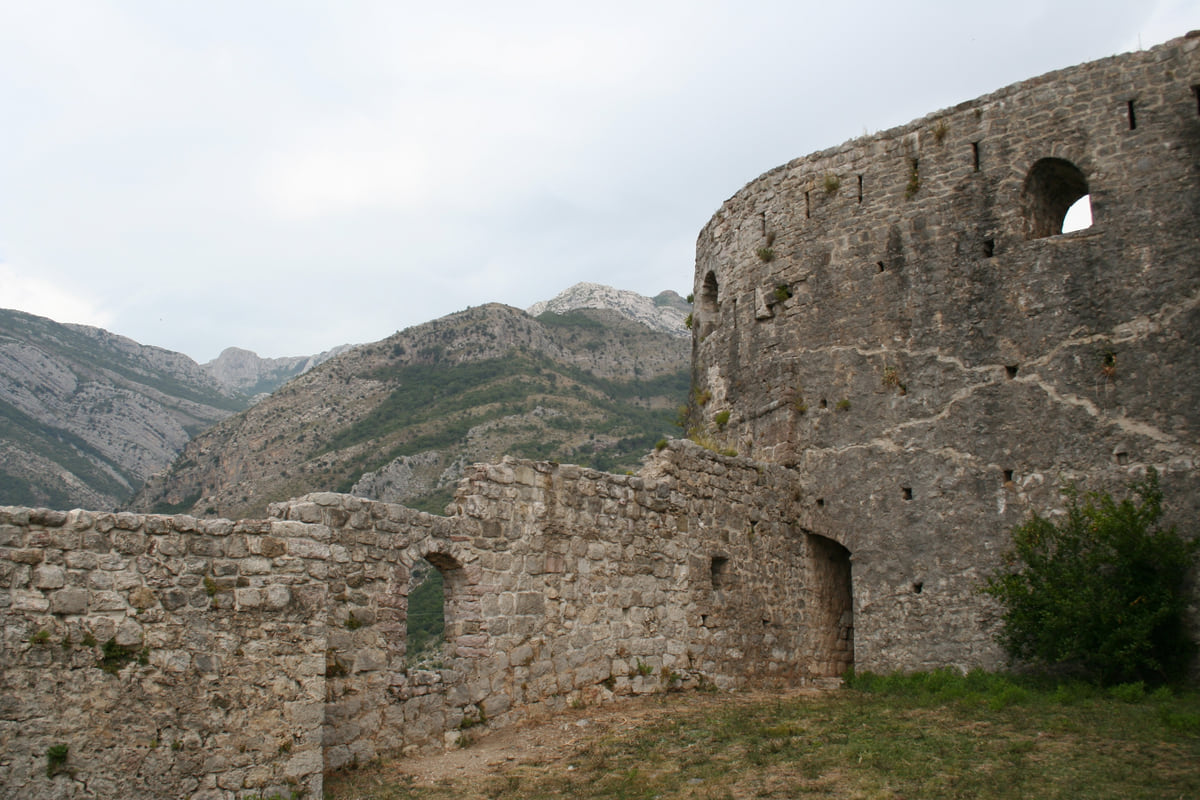
Old Bar, 4 km inland from the coast
Stari Bar, Montenegro's Pompeii on a rock
Stari Bar, or Old Bar, is the original town of Bar, abandoned and in ruins on a rock at the foot of Mount Rumija, 4 km from the sea. It keeps the remains of more than 260 buildings, a 17-arch Ottoman aqueduct, Turkish baths and a clock tower. Entry is €3 and it opens from 8:00 to 21:00 in season.
In 30 seconds
Full read: 3 min
- Stari Bar is the abandoned medieval town above Bar, 4 km from the sea.
- It has the remains of more than 260 buildings, a 17-arch aqueduct and Turkish baths.
- Entry is €3 and it opens 8:00 to 21:00 in season.
- The Ottoman-era bazaar carries on below the walls.
For me this is the best visit on the whole southern coast, and one of the few that's cheap and rarely crowded. I'd be at the gate for eight, in shoes with a thick sole because you're walking on loose stone, and then wander down the bazaar street for a drink.

Before you go
What I would keep in mind
-
01 Most beautiful
The view from the walls
From the ramparts you look over the Bar plain, the new town, the port, the open sea and the Rumija massif, as the Bar tourist board puts it.
Mount Rumija -
02 To save money
A whole town for €3
Adult entry is €3 and children up to 12 pay €1. Add the €1 old olive tree at Mirovica and you've got half a day for under a fiver.
old olive tree of Mirovica -
03 My tip
The aqueduct sits outside the walls
The Ottoman aqueduct is on the north side, 17 arches on massive piers. It brought water from a spring about 3 km away.
-
04 Worth the splurge
Drop into the bazaar
Below the walls the Ottoman-era market carries on, protected as a monument, with stalls of olives, olive oil, citrus and cheese.
Bar -
05 To save money
A canyon ten minutes away
Rikavac canyon starts next to Stari Bar, a ten-minute walk from the car park, with 1 km and six vertical drops, according to the Bar tourist board.
canyoning in Montenegro -
06 Most beautiful
On foot to the Rikavac bridge
The Bar tourist board waymarks a 6.5 km trail of moderate difficulty that leaves Stari Bar and ends at the Rikavac bridge.
hiking in Montenegro
What I would book
Some ruins take ten minutes. Others need a morning, and Stari Bar is one of those. It isn’t a castle or a single monument; it’s an entire town left empty on its rock, with streets, churches, mosques, baths and roofless houses, and you can wander it with hardly anyone else about.
Why it’s in ruins
The Bar tourist board describes a fortified town built on a huge rock massif, unreachable from the east and south, which for centuries was the seat from which the surrounding lands were ruled. Byzantines, Slavs, Venetians and Turks all passed through and left their mark. Only when the threat of war faded did people move down to the plain by the sea, where the new town of Bar grew up in the twentieth century. The national tourism office calls it Montenegro’s Pompeii and speaks of the ruins of more than 260 buildings.
What you’ll see inside
The walk takes you from the walls past the remains of palaces, churches, mosques, Turkish baths and the clock tower, renovated in 1753 when it took on its oriental look. The hammam keeps its dome on squinches, pierced by small openings for light and air. From the top of the walls, says the tourist board, you take in the Bar plain, the new town, the port, the open sea and the Rumija massif. What I like most is that it hasn’t been over-restored, so you can tell what’s original.
If you are staying the night, see the best hotel deals in Bar for your dates: the well-placed rooms go fast.
The aqueduct and the olive grove
Outside the walls on the north side is the aqueduct the Ottomans built in the seventeenth century to bring water from a spring about 3 km away. It’s 17 arches of varying span on as many piers, and it’s the photo everyone takes home. Around it spreads the Džidžarin olive grove, one of the largest and most valuable in Bar, reached only on foot along the old cobbled track. The local olive growers have waymarked it as the Olive Paths, and in 2016, while the path was being laid, the remains of a medieval chapel thought to date from the thirteenth century turned up. The tourist board says there were once up to 100,000 olive trees here, and the most famous of all is the old olive tree of Mirovica.
The bazaar below
At the foot of the old town is the market founded by the Ottomans, which took its present shape in the eighteenth and nineteenth centuries and is protected as a monument. Its street plan is oriental and its houses follow the Balkan folk tradition. The tourist board mentions stallholders in traditional dress selling citrus fruit, olives, olive oil, cheese and handicrafts. It’s the place for a bite after your visit.
So you do not lose the morning at the ticket office, browse tickets and tours in Stari Bar on GetYourGuide.
The old town’s mosques
The Ottoman legacy goes beyond the bazaar. Inside Stari Bar the Omerbašića Mosque still stands, built in 1662, plain and rectangular with its minaret set against the south-west wall, and protected as a cultural monument. By the entrance to its precinct is the mausoleum of Dervish Hasan from the early 17th century, with a public fountain and a house for the imam, all enclosed by a stone wall. The tourist board also mentions the Škanjevića Mosque. Close by, in Gornja Čeluga, rises the Selimija, one of the largest mosques in the Balkans, built on land that Fatima Omerbašić left to the Islamic community in the 19th century. The national tourist board holds it up, along with St Peter’s co-cathedral and the church of St Jovan Vladimir, as an example of places of worship of three faiths standing close together.
Planning your visit
Entry is €3, and €1 for children up to 12. Summer hours are 8:00 to 21:00, and out of season it shuts at 17:00. Early morning or the end of the afternoon is best, as the rock has no shade and in summer you’ll feel it. For walkers, a waymarked 6.5 km route links Stari Bar with Kajnak, Džidžarin and the Rikavac bridge, and the Vruća rijeka canyoning route finishes right by the walls. Shorter is the Rikavac canyon next to the old town, a kilometre long with six abseils, ten minutes on foot from the car park and doable in summer. If you’re still keen on old stone afterwards, the next step is Haj-Nehaj fortress above Sutomore.
If you are staying the night, see the best hotel deals in Bar for your dates: the well-placed rooms go fast.
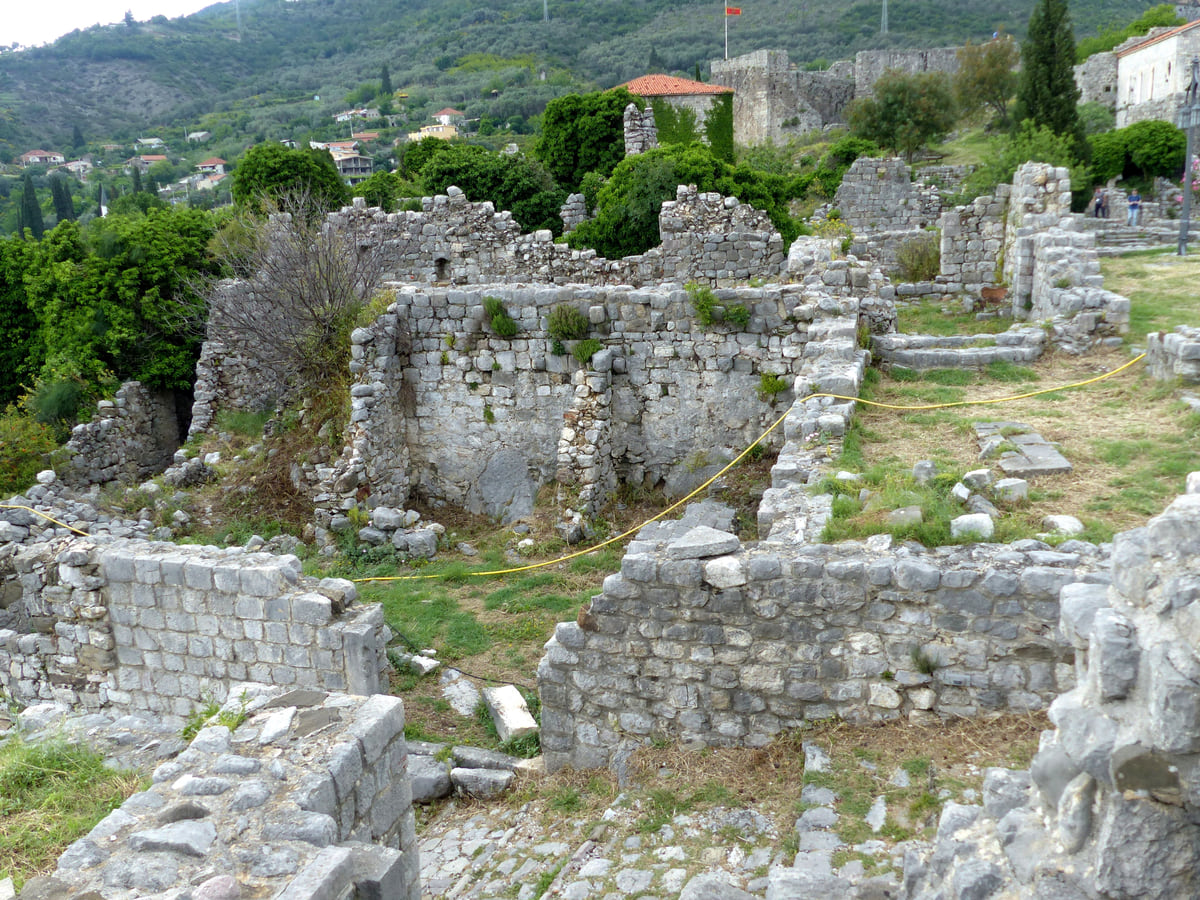
Ruined stone houses in Stari Bar among grass and trees, with roofless walls and the green hillside behind
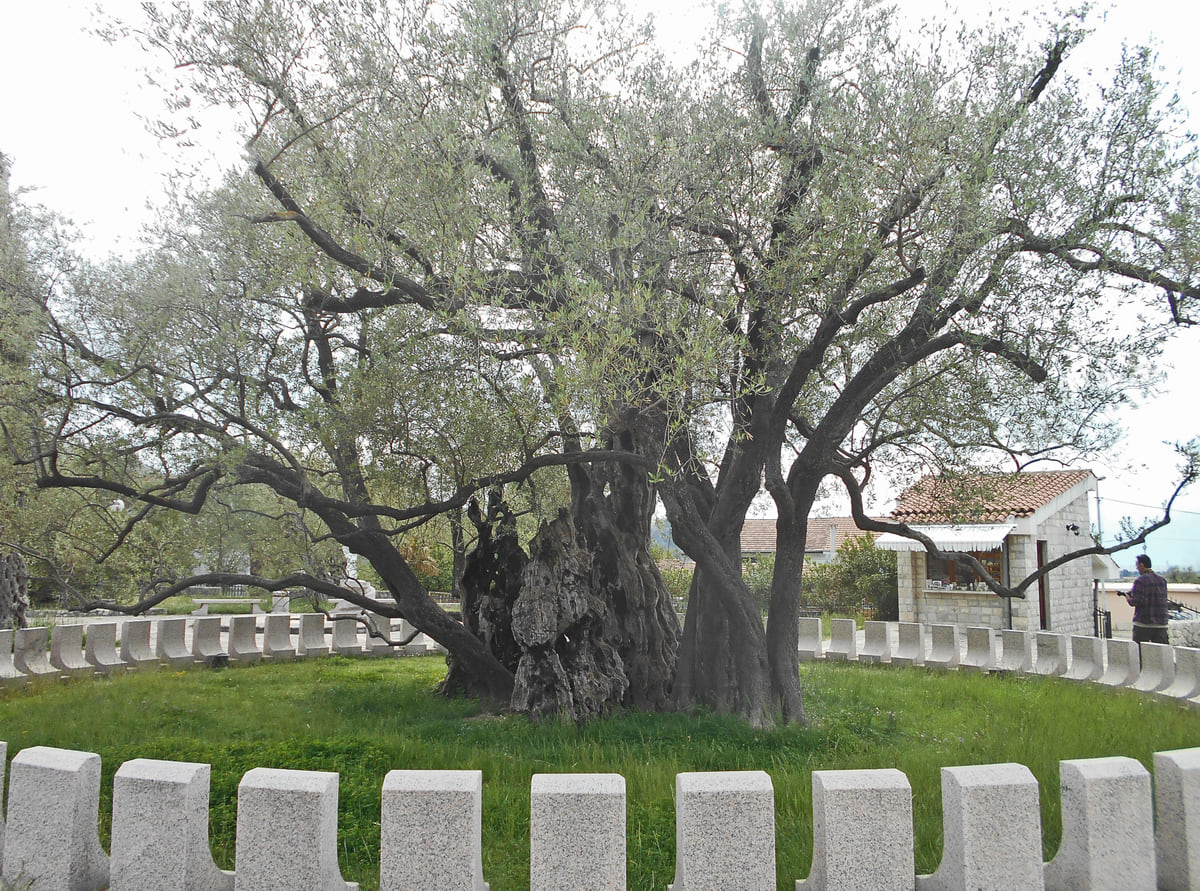
The old olive tree of Mirovica in Bar, its twisted, hollow trunk standing on a lawn ringed by a low white stone wall
Visiting Stari Bar
| Detail | Value |
|---|---|
| Adult entry | €3 |
| Children up to 12 | €1 |
| Hours in season | 8:00-21:00 |
| Hours out of season | 8:00-17:00 |
Bar tourist board, Stari Bar listing, checked on 11 October 2026.
Test yourself
True or false?
0/3 Pick before you peek.
-
Stari Bar is right on the seafront.
See the answer
False. It's 4 km inland, on a rock at the foot of Rumija. Modern Bar was built down by the sea in the twentieth century.
-
Stari Bar's aqueduct dates from Ottoman times.
See the answer
True. The Ottomans built it in the seventeenth century to bring water from a spring about 3 km away. It has 17 arches.
-
There were once up to 100,000 olive trees around Stari Bar.
See the answer
True. The Bar tourist board says there used to be up to 100,000 centuries-old olive trees, the town's emblem.
- Ruined buildings, at least
- 260
- Arches on the aqueduct
- 17
- Distance from the sea
- 4 km
- Adult entry
- €3
Map
Where Stari Bar is
The Adriatic coast runs from Herceg Novi to Ulcinj; the centre holds Podgorica, Cetinje and Lake Skadar, and the north, Durmitor and the Tara Canyon. Every number opens its guide.
 1Stari Bar 2Old olive tree of Mirovica 3Mount Rumija 4Sutomore 5Čanj 6Bar Riviera 7Crvena stijena 8Bar 9Virpazar 10Godinje
 Map data © OpenStreetMap contributors (ODbL)
- 1Stari BarOld Bar, 4 km inland from the coast
- 2Old olive tree of MirovicaNatural monument in Bar
- 3Mount RumijaMountain in Bar municipality
- 4SutomoreBar Riviera, a few kilometres from Bar
- 5ČanjBar Riviera, between Sutomore and Petrovac
- 6Bar RivieraSouth of Bar, on the road to Ulcinj
- 7Crvena stijenaVolujica peninsula, Bar
- 8BarSouthern Montenegrin coast
- 9VirpazarLake Skadar village, Bar municipality
- 10GodinjeWine village, Bar municipality
0 of 278 Montenegro guides
Your next stamp
- Bar
- Svač
- Bar Riviera
- Kotor Old Town
- Stara Varoš
- Aman Sveti Stefan
- Budva Old Town
- Haj-Nehaj
- Kotor
- Lučice Beach
- Montenegro's coast
- Peaks of the Balkans
- Porto Montenegro
- Sea Dance Festival
- Splendid Conference & Spa Resort
- Ulcinj Old Town
- Bay of Kotor
- Budva Riviera
- Heroj submarine
- Iberostar Bellevue
- Independence Day
- Old olive tree of Mirovica
- Tivat
- Velika plaža
- Ada Bojana
- Beaches in Budva
- Eurostars Queen of Montenegro
- Herceg Novi
- Mount Rumija
- Igalo
- Kotor city walls
- Mogren Beach
- Montenegro Beach Resort
- Vrmac
- Hiking
- Jaz Beach
- Kanli kula
- Luštica peninsula
- St Tryphon Cathedral
- Ulcinj salt pans
- Forte Mare
- Gornja Lastva
- Maritime Museum, Kotor
- Slovenska Beach
- Drobni Pijesak Beach
- Kotor viewpoints
- Mamula
- Žanjic beach
- Kotor cruise port
- Orjen
- Plavi horizonti beach
- Sveti Nikola Island
- Blue Cave
- Restaurants in Budva
- Restaurants in Kotor
- Canyoning
- Hotels
- Perast
- Sutomore
- Sveti Stefan
- Čanj
- Luxury hotels
- Our Lady of the Rocks
- Pržno
- Things to do
- Activities
- All-inclusive hotels
- Bečići
- Hotel Palma
- St George island
- Dobrota
- Hladna uvala
- Most beautiful places
- Petrovac
- Crvena stijena
- Prčanj
- Prettiest villages
- Cycling
- Risan
- UNESCO sites
- Heritage Grand Perast
- Map
- Hyatt Regency Kotor Bay
- Where is it?
- Regions
- Cities
- Beaches in Bar
- Budva
- Central Montenegro
- Hotels in Budva
- Hotels in Kotor
- Iberostar Waves Herceg Novi
- Kitesurfing
- The name
- Beaches in Ulcinj
- Flag
- Hotels in Perast
- Palmon Bay Hotel & Spa
- Podgorica
- Cathedral of the Resurrection
- One&Only Portonovi
- Population
- Sandy beaches
- Azul Beach Resort Montenegro
- Naturist beaches
- Size
- Doclea
- Language
- Mimosa Festival
- Medun
- Religion
- Zipline
- Currency
- Museums in Podgorica
- Dajbabe Monastery
- EU membership
- History
- Restaurants in Podgorica
- Hotels in Podgorica
- Public holidays
- Avala Resort & Villas
- Beaches in Kotor
- Birdwatching
- Hotels in Ulcinj
- Kotor carnival
- Time zone
- Tivat beaches
- Tuzi
- Boka Night
- Dukley Hotel & Resort
- Facts
- Hotels in Tivat
- Zeta
- Caves
- Herceg Novi beaches
- National parks
- Šipčanik
- Hotels in Herceg Novi
- Monasteries
- Fortresses
- Fly fishing
- Museums
- Canyons and waterfalls
- Lakes
- Mountains
- Montenegro and Croatia
- Beaches
- Boat trips
- Cetinje
- Montenegro and Albania
- Nightlife
- Ulcinj
- Weather
- Best time to visit
- Cetinje Monastery
- Kayaking
- Montenegro and the Balkans
- How to get there
- In summer
- King Nikola's Palace
- Sailing
- Biljarda
- Flights
- In winter
- Airports
- Museums in Cetinje
- New Year's Eve
- Lovćen
- Paragliding
- Tivat Airport
- Njegoš Mausoleum
- Podgorica Airport
- Dubrovnik to Kotor
- Kotor serpentine
- Belgrade to Montenegro
- Njeguši
- Ferry to Italy
- Njeguši prosciutto
- Border crossings
- In January
- Lipa Cave
- Where to stay
- In February
- Kamenari-Lepetane ferry
- Pavlova strana
- Getting around
- In March
- Rijeka Crnojevića
- In April
- Trains
- Buses
- In May
- Car hire
- In June
- Driving
- In July
- In August
- Taxis
- Distances
- In September
- In October
- Road trip
- Food
- In November
- Lake Skadar
- Scenic drives
- In December
- Kotor cable car
- Virpazar
- Where to eat
- Budva to Kotor
- Godinje
- Wine
- Podgorica to Kotor
- Vranjina
- Besac fortress
- Prices and budget
- On a budget
- Žabljak Crnojevića
- Danilovgrad
- Entry requirements
- Ostrog Monastery
- Tourist registration
- Customs
- Nikšić
- Crvena Stijena cave
- Safety
- Events
- Healthcare
- Northern Montenegro
- Mobile and roaming
- Žabljak
- Durmitor
- Plugs
- Black Lake
- With kids
- Bobotov Kuk
- Holidays
- Day trips
- Stećci tombstones
- Hotels in Žabljak
- Three-day itinerary
- Five-day itinerary
- Skiing in Montenegro
- One-week itinerary
- Skiing in Žabljak
- Šavnik
- Ten-day itinerary
- Nevidio Canyon
- Tara Canyon
- Tara rafting
- Đurđevića Tara Bridge
- Plužine
- Lake Piva
- Piva Monastery
- Mojkovac
- Brskovo
- Pljevlja
- Husein Pasha Mosque
- Kolašin
- Hotels in Kolašin
- Skiing in Kolašin
- Biogradska Gora National Park
- Komovi
- Morača Monastery
- Morača Canyon
- Bijelo Polje
- Đalovića Cave
- Berane
- Andrijevica
- Petnjica
- Rožaje
- Plav
- Lake Plav
- Gusinje
- Vusanje
- Prokletije National Park
Frequently asked questions
Is Stari Bar worth visiting?
I think so. It's a whole medieval walled town left in ruins on a rock, with more than 260 buildings, an aqueduct and a bazaar below, for €3 and usually without crowds.
How much is entry to Stari Bar?
€3 for adults and €1 for children up to 12, according to the Bar tourist board. It opens 8:00 to 21:00 in season and 8:00 to 17:00 the rest of the year.
How do you get from Bar to Stari Bar?
It's 4 km up from the new town of Bar. A car or taxi is easiest; on foot it's uphill all the way.
What is there to see in Stari Bar?
The walls and their views, the 17-arch Ottoman aqueduct, the clock tower, the Turkish baths, ruined churches and mosques and, outside, the old bazaar and the Džidžarin olive grove.
How long do you need at Stari Bar?
I'd allow an hour and a half to two hours for the old town, plus half an hour for the bazaar and the aqueduct.
Is Stari Bar the same as Bar?
No. Bar is the modern port town by the sea, built in the twentieth century. Stari Bar is the old town it replaced, up on its rock 4 km inland.
By
Tourism graduate with a master’s in Tourism Management and Planning from the University of Málaga, who has travelled across Europe. He writes every guide from official sources and his own judgement.
Published on . Facts checked on .
Sources
Some links in this guide are affiliate links: if you book through them, the site earns a commission at no extra cost to you. Affiliate disclosure
Photos: chenyingphoto (CC BY 2.0); Wolfgang Sauber (CC BY-SA 4.0); BuhaM (CC BY-SA 4.0), via Wikimedia Commons.