Shrine of St Basil of Ostrog
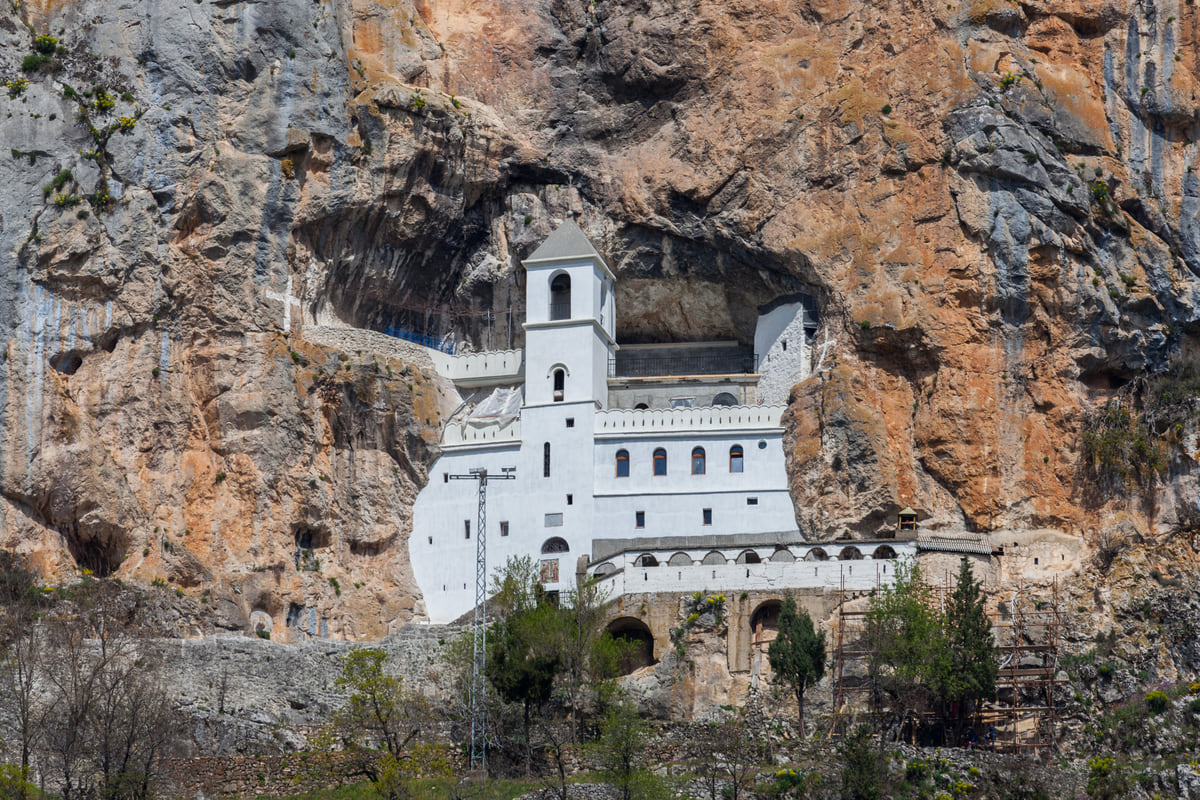
Ostrog Monastery, built into the face of the mountain
Ostrog Monastery is an Orthodox shrine set into a cliff at around 900 metres, above the Zeta valley between Danilovgrad and Nikšić. It comes in two parts, the lower monastery with the church of the Holy Trinity, and the upper one, with cave churches painted in the 17th century and the relics of St Basil of Ostrog, who died here in 1671.
In 30 seconds
Full read: 3 min
- Ostrog Monastery is set into a cliff at about 900 m above the Zeta valley.
- It's one of the most visited monasteries in the Orthodox world, according to the National Tourism Organisation.
- St Basil, who died here in 1671, lies in a church cut into the rock.
- The monastery publishes no opening hours or admission price.
Ostrog is a working place of worship first and a sight second, and that's how to approach it. I'd arrive early, park at the lower monastery and walk the last stretch as pilgrims do, then go into the relic cave quietly and without rushing.

Before you go
What I would keep in mind
-
01 Most beautiful
A church inside the rock
The church of the Presentation of the Virgin, which holds St Basil's relics, is cut into the cliff. According to the monastery itself, only children and the elderly get through its doorway without stooping low.
-
02 My tip
Lower to upper in half an hour on foot
The monastery says it's no more than half an hour's walk, or about ten minutes by car, from the lower monastery to the upper terrace. The National Tourism Organisation mentions a 3 km pilgrim climb through the forest.
-
03 Getting there
Turn off at Bogetići
The road up leaves the Podgorica to Nikšić highway at Bogetići and climbs over the Povija pass almost to the top of the Ostrog ridge, according to the monastery.
Danilovgrad -
04 To save money
Stay beside the shrine
The monastery runs a guest house with its own phone line (+382 68 080 133). It doesn't publish prices online, so you'll need to ring.
-
05 Most beautiful
Another monastery in the rock
If Ostrog impresses you, look at Dajbabe in Podgorica, founded in 1897 inside a natural cave and painted by its own founder.
Dajbabe Monastery -
06 Most beautiful
The Piva frescoes
Further north, Piva Monastery, from 1573, keeps 1,250 m² of frescoes moved stone by stone because of the dam.
Piva Monastery
What I would book
- Tours and ticketsGetYourGuide A day trip to Ostrog from the coast If you're not driving, it's the simplest way to get there from the coast; with your own car you can set off earlier.
- Places to stayBooking.com Stay in Nikšić It's the nearest big town to Ostrog from the north and puts you at the monastery first thing.
Few images of Montenegro are as recognisable as this one, a white facade stuck to a rock face halfway up a mountain. Ostrog is the country’s great shrine, and the state tourism office counts it among the most visited monasteries in the Orthodox world. I think it’s worth the detour even if you’re not religious, for the setting and the atmosphere, but go knowing it isn’t a museum.
A 17th-century sanctuary
The name comes from an old fort, Ostrog, which the monastery’s history says appears in charters of King Alfonso V of Naples in 1444 and 1454 and in Mauro Orbini’s book of 1601. The monastery came two centuries later, in the hermit caves of St Isaiah of Onogošt and his companions at the start of the 17th century, with the blessing of the bishop everyone knows as St Basil of Ostrog.
St Basil was born in December 1610 at Mrkonjići, in the Popovo Polje of Herzegovina, spent his final five years at Ostrog and died in his cell in 1671. Danilovgrad municipality sums it up by saying that since that year it has ranked among the Balkans’ foremost shrines, and that its cave churches with 17th-century wall paintings form a unique ensemble.
Lower and upper monastery
The monastery’s website describes the route well. The road leaves the Podgorica to Nikšić highway at Bogetići, climbs over the Povija pass and reaches the lower monastery first, with the church of the Holy Trinity, a railed viewpoint with benches, the guest quarters and a well. From there it’s no more than half an hour on foot, or about ten minutes by car, to the upper terrace at the foot of the ridge.
The National Tourism Organisation mentions the 3 km climb that pilgrims make through the forest and the view from around 900 metres over the Zeta valley and the mountains of central Montenegro. I’d walk it if the weather and your legs allow. Arriving slowly helps you make sense of the place.
Once your dates are set, check which hotels are still free in Nikšić before prices climb.
The relic cave
At the top, the terrace narrows into a flight of steps and a ledge of pale stone hanging over the drop, which leads into the church of the Presentation of the Virgin, inside the rock. St Basil’s relics rest here beneath frescoes of St Constantine and St Helena, St Sava and the warrior saints. The doorway is so low that, the monastery says, only children and the elderly get through without stooping.
Higher still, steps cut into the rock lead to the church of the Holy Cross and the ancient vine that, according to the monastery’s tradition, sprang up where the saint died. The National Tourism Organisation stresses that people of every faith come here to pray.
What isn’t published, and how I’d do it
Neither the monastery’s website nor the official tourism sources give visiting hours, an admission price or a dress code. It’s an active place of worship, so I’d wear clothes that cover shoulders and knees, out of respect and before anyone has to ask. For somewhere to sleep nearby, the monastery has a guest house with its own phone line, and Nikšić is just north along the same road.
For the country’s other great monasteries, such as Cetinje and Morača, see my guide to monasteries in Montenegro. And if you climb, the National Tourism Organisation mentions a bolted rock up to 20 metres high at the village of Povija, near Ostrog, with five routes graded V to VII.
Once your dates are set, check which hotels are still free in Nikšić before prices climb.
Ostrog at a glance
| Detail | Value | Source |
|---|---|---|
| Altitude of the upper monastery | About 900 m | National Tourism Organisation |
| Frescoes in the cave churches | 17th century | National Tourism Organisation |
| Pilgrim climb | 3 km through the forest | National Tourism Organisation |
| Lower to upper monastery | Half an hour on foot or 10 min by car | Ostrog Monastery |
| St Basil born | December 1610, Mrkonjići (Herzegovina) | Ostrog Monastery |
| St Basil died | 1671, in his cell at Ostrog | Ostrog Monastery |
Checked on 10 October 2026. The monastery's website gives no visiting hours, admission price or dress code.
Test yourself
True or false?
0/3 Pick before you peek.
-
You can only reach Ostrog Monastery on foot.
See the answer
False. A road runs to the lower monastery and on to the upper one, about ten minutes by car. Pilgrims often walk the 3 km climb instead.
-
St Basil of Ostrog was born in Montenegro.
See the answer
False. He was born in December 1610 at Mrkonjići, in the Popovo Polje of Herzegovina, according to the monastery's website.
-
Ostrog has an upper and a lower monastery.
See the answer
True. The lower one has the church of the Holy Trinity; the upper one has the cave churches and the relics, according to the monastery.
- Approximate altitude of the upper monastery
- 900 m
- St Basil dies at Ostrog
- 1671
- Pilgrim climb through the forest
- 3 km
- Date of the cave church frescoes
- 17th c.
Map
Where Ostrog Monastery is
The Adriatic coast runs from Herceg Novi to Ulcinj; the centre holds Podgorica, Cetinje and Lake Skadar, and the north, Durmitor and the Tara Canyon. Every number opens its guide.

0 of 278 Montenegro guides
Your next stamp
- Monasteries
- Cetinje Monastery
- Piva Monastery
- Danilovgrad
- Cetinje
- Berane
- Religion
- Aman Sveti Stefan
- Budva Old Town
- Haj-Nehaj
- Kotor
- Lučice Beach
- Montenegro's coast
- Peaks of the Balkans
- Porto Montenegro
- Sea Dance Festival
- Splendid Conference & Spa Resort
- Stari Bar
- Ulcinj Old Town
- Bay of Kotor
- Budva Riviera
- Heroj submarine
- Iberostar Bellevue
- Independence Day
- Old olive tree of Mirovica
- Tivat
- Velika plaža
- Ada Bojana
- Beaches in Budva
- Eurostars Queen of Montenegro
- Herceg Novi
- Kotor Old Town
- Mount Rumija
- Igalo
- Kotor city walls
- Mogren Beach
- Montenegro Beach Resort
- Svač
- Vrmac
- Hiking
- Jaz Beach
- Kanli kula
- Luštica peninsula
- St Tryphon Cathedral
- Ulcinj salt pans
- Forte Mare
- Gornja Lastva
- Maritime Museum, Kotor
- Slovenska Beach
- Drobni Pijesak Beach
- Kotor viewpoints
- Mamula
- Žanjic beach
- Kotor cruise port
- Orjen
- Plavi horizonti beach
- Sveti Nikola Island
- Blue Cave
- Restaurants in Budva
- Restaurants in Kotor
- Canyoning
- Hotels
- Perast
- Sutomore
- Sveti Stefan
- Čanj
- Luxury hotels
- Our Lady of the Rocks
- Pržno
- Things to do
- Activities
- All-inclusive hotels
- Bar Riviera
- Bečići
- Hotel Palma
- St George island
- Dobrota
- Hladna uvala
- Most beautiful places
- Petrovac
- Crvena stijena
- Prčanj
- Prettiest villages
- Cycling
- Risan
- UNESCO sites
- Heritage Grand Perast
- Map
- Hyatt Regency Kotor Bay
- Where is it?
- Regions
- Cities
- Beaches in Bar
- Budva
- Central Montenegro
- Hotels in Budva
- Hotels in Kotor
- Iberostar Waves Herceg Novi
- Kitesurfing
- The name
- Beaches in Ulcinj
- Flag
- Hotels in Perast
- Palmon Bay Hotel & Spa
- Podgorica
- Cathedral of the Resurrection
- One&Only Portonovi
- Population
- Sandy beaches
- Azul Beach Resort Montenegro
- Naturist beaches
- Size
- Stara Varoš
- Doclea
- Language
- Mimosa Festival
- Medun
- Zipline
- Currency
- Museums in Podgorica
- Dajbabe Monastery
- EU membership
- History
- Restaurants in Podgorica
- Hotels in Podgorica
- Public holidays
- Avala Resort & Villas
- Bar
- Beaches in Kotor
- Birdwatching
- Hotels in Ulcinj
- Kotor carnival
- Time zone
- Tivat beaches
- Tuzi
- Boka Night
- Dukley Hotel & Resort
- Facts
- Hotels in Tivat
- Zeta
- Caves
- Herceg Novi beaches
- National parks
- Šipčanik
- Hotels in Herceg Novi
- Fortresses
- Fly fishing
- Museums
- Canyons and waterfalls
- Lakes
- Mountains
- Montenegro and Croatia
- Beaches
- Boat trips
- Montenegro and Albania
- Nightlife
- Ulcinj
- Weather
- Best time to visit
- Kayaking
- Montenegro and the Balkans
- How to get there
- In summer
- King Nikola's Palace
- Sailing
- Biljarda
- Flights
- In winter
- Airports
- Museums in Cetinje
- New Year's Eve
- Lovćen
- Paragliding
- Tivat Airport
- Njegoš Mausoleum
- Podgorica Airport
- Dubrovnik to Kotor
- Kotor serpentine
- Belgrade to Montenegro
- Njeguši
- Ferry to Italy
- Njeguši prosciutto
- Border crossings
- In January
- Lipa Cave
- Where to stay
- In February
- Kamenari-Lepetane ferry
- Pavlova strana
- Getting around
- In March
- Rijeka Crnojevića
- In April
- Trains
- Buses
- In May
- Car hire
- In June
- Driving
- In July
- In August
- Taxis
- Distances
- In September
- In October
- Road trip
- Food
- In November
- Lake Skadar
- Scenic drives
- In December
- Kotor cable car
- Virpazar
- Where to eat
- Budva to Kotor
- Godinje
- Wine
- Podgorica to Kotor
- Vranjina
- Besac fortress
- Prices and budget
- On a budget
- Žabljak Crnojevića
- Entry requirements
- Tourist registration
- Customs
- Nikšić
- Crvena Stijena cave
- Safety
- Events
- Healthcare
- Northern Montenegro
- Mobile and roaming
- Žabljak
- Durmitor
- Plugs
- Black Lake
- With kids
- Bobotov Kuk
- Holidays
- Day trips
- Stećci tombstones
- Hotels in Žabljak
- Three-day itinerary
- Five-day itinerary
- Skiing in Montenegro
- One-week itinerary
- Skiing in Žabljak
- Šavnik
- Ten-day itinerary
- Nevidio Canyon
- Tara Canyon
- Tara rafting
- Đurđevića Tara Bridge
- Plužine
- Lake Piva
- Mojkovac
- Brskovo
- Pljevlja
- Husein Pasha Mosque
- Kolašin
- Hotels in Kolašin
- Skiing in Kolašin
- Biogradska Gora National Park
- Komovi
- Morača Monastery
- Morača Canyon
- Bijelo Polje
- Đalovića Cave
- Andrijevica
- Petnjica
- Rožaje
- Plav
- Lake Plav
- Gusinje
- Vusanje
- Prokletije National Park
Frequently asked questions
How do you get to Ostrog Monastery from Podgorica?
Drive north on the Podgorica to Nikšić road and turn off at Bogetići, then follow the mountain road over the Povija pass to the lower monastery. From there it's half an hour on foot or about ten minutes by car to the upper monastery.
Can you visit Ostrog Monastery from Kotor?
Yes, as a long day out. By car you join the Podgorica to Nikšić road and turn off at Bogetići; if you'd rather not drive, organised day trips run from the coast.
Is there an entry fee for Ostrog Monastery?
The monastery's website publishes no admission price or parking charge. It's an active place of worship, so any charge would be shown on site.
What should I wear to Ostrog Monastery?
The monastery doesn't publish a dress code. As at any Orthodox shrine, I'd cover shoulders and knees out of respect.
Who was St Basil of Ostrog?
An Orthodox bishop born in December 1610 at Mrkonjići in Herzegovina, who spent his last five years at Ostrog and died in his cell in 1671. His relics are kept in the cave church.
Which town is Ostrog Monastery in?
It sits on the Ostrog ridge between Danilovgrad and Nikšić. OpenStreetMap places both monasteries in Danilovgrad municipality, while the monastery's postal address is Nikšić.
By
Tourism graduate with a master’s in Tourism Management and Planning from the University of Málaga, who has travelled across Europe. He writes every guide from official sources and his own judgement.
Published on . Facts checked on .
Sources
Some links in this guide are affiliate links: if you book through them, the site earns a commission at no extra cost to you. Affiliate disclosure
Photos: Diego Delso (CC BY-SA 3.0), via Wikimedia Commons.