Eating in Montenegro
Montenegrin food, from the coast to the mountain katuns
Montenegrin food changes with the landscape. On the coast it's fish and olive oil; on Lake Skadar, smoked carp, bleak and eel; and in the mountains, Njeguši prosciutto, lamb cooked under the sač, cheeses such as Kolašin's lisnati, kajmak and kačamak. It's washed down with Vranac red wine, rakija or medovina, the local mead.
In 30 seconds
Full read: 2 min
- Montenegrin food changes with the landscape, from the coast to Lake Skadar and the mountains.
- The classics are Njeguši prosciutto, lamb under the sač, smoked carp and cheeses such as lisnati.
- In the mountains it's kačamak with kajmak; on the coast, fish with olive oil.
- Drinks include Vranac wine, rakija and medovina.
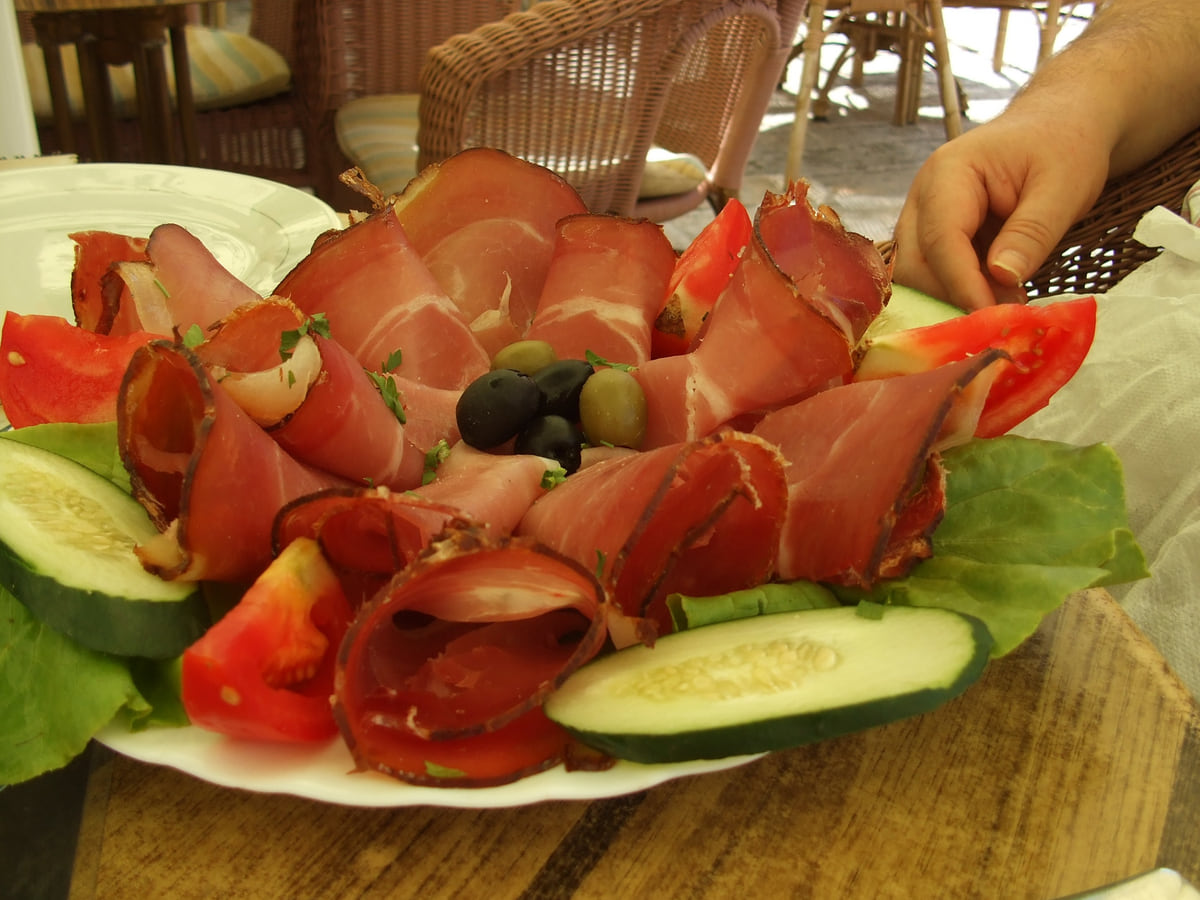
If I could only eat three things in Montenegro, they'd be a plate of Njeguši prosciutto with Njeguši cheese, smoked carp on a terrace by Lake Skadar and lamb from under the sač in a mountain katun. Together they tell you more about the country than any seafront restaurant.

Before you go
What I would keep in mind
-
01 Most beautiful
The prosciutto's secret is in the air
The national tourist board explains that pršut and kastradina are dried where sea air meets mountain air, at 500 to 1,500 metres above sea level.
Njeguši prosciutto -
02 My tip
Carp, salted and smoked over two days
The traditional recipe is to salt the carp for 24 hours and smoke it for another 24 over wild pomegranate or willow wood, according to the national tourist board.
Lake Skadar -
03 To save money
Buy at the market
The Bar tourist board points you to the town's main market and Stari Bar's main street for olive oil, olives, honey and dried figs straight from the growers.
old olive tree of Mirovica -
04 Worth the splurge
Cheese and honey trails
On Bjelasica, around Kolašin, the katuns still make lisnati cheese, and the national tourist board suggests routes taking in cheesemakers and beekeepers.
Kolašin -
05 Getting there
Buzara mussels in Kotor
In Kotor it's all about fish from the bay, with buzara mussels, squid and risotto, and krempita from the Forza patisserie for pudding.
Kotor restaurants -
06 Most beautiful
Pljevlja cheese
Aged Pljevlja cheese is one of the country's classics. The town, in the far north, has 24,134 people in its municipality.
Pljevlja
What I would book
In Montenegro you eat according to the landscape, and in a country this small that means you can go from fish and olive oil to mountain lamb and lake carp in the space of a week. I find it one of the most honest cuisines in the Balkans, built on whatever each place produces and without too much fuss.
The mountains, lamb, cheese and prosciutto
The national tourist board starts with the air-dried meats. Njeguši prosciutto, made from pork ham, is the most famous, along with Njeguši sausage, košet, dried leg of mutton, and kastradina, dried mutton. The secret, it says, is the climate, where sea air meets mountain air, and the altitude, between 500 and 1,500 metres. For lamb, it recommends steaks cooked in milk or slow-roasted beneath the sač, a hot iron dome covered in embers. For cheese, there’s smoked Njeguši, aged Pljevlja, masni kučki, fresh krajinski goat’s cheese and lisnati, made in fine layers and still produced in the katuns of Bjelasica around Kolašin. Up there you’ll also find kačamak, made from potato or maize with cheeses and kajmak, a thick clotted cream, and jardum, a specially prepared sheep’s milk.
The lake, carp and bleak
On Lake Skadar the star is carp. The traditional recipe, according to the national tourist board, is to salt it for 24 hours, rinse it and smoke it for another 24 over wild pomegranate or willow wood, which gives the flesh a reddish colour. It’s also baked on a bed of onions with plums, quinces and apples, or dried and dressed with olive oil, garlic, parsley and lemon. Bleak, a small fish found only in the lake, is fried whole or eaten dried and smoked, and eel is baked over rice with onions, carrots and prunes.
To sleep close to everything, search places to stay in Virpazar on Expedia and filter by area before price.
The coast, olive oil, olives and pomegranates
The Bar tourist board says more than 100,000 olive trees grow across the municipality, including the old olive tree of Mirovica, and a cuisine drawn from sea, lake, vineyard and olive grove. Its list runs from priganice with honey, japraci and dolma to štufada, raštan, pies of every kind, olives prepared a dozen ways and halva, all washed down with Crmnica Vranac. In Ulcinj, the market sells olives, oil, cheese, oranges, dried figs and sudžuk, a cured beef.
What to drink
The national tourist board singles out medovina, mead, as the drink Montenegrins are proudest of, along with red wine and home-made rakija. Wine deserves a page of its own, Montenegro wine.
If you are short on time, see the best tours in Virpazar and pick one that fits your day.
Where to try it
Mountain dishes are best in villages and katuns, and lake fish in Virpazar or Rijeka Crnojevića. On the coast there’s no shortage of restaurants; I suggest where to start in where to eat in Montenegro.
To sleep close to everything, search places to stay in Virpazar on Booking.com and filter by area before price.
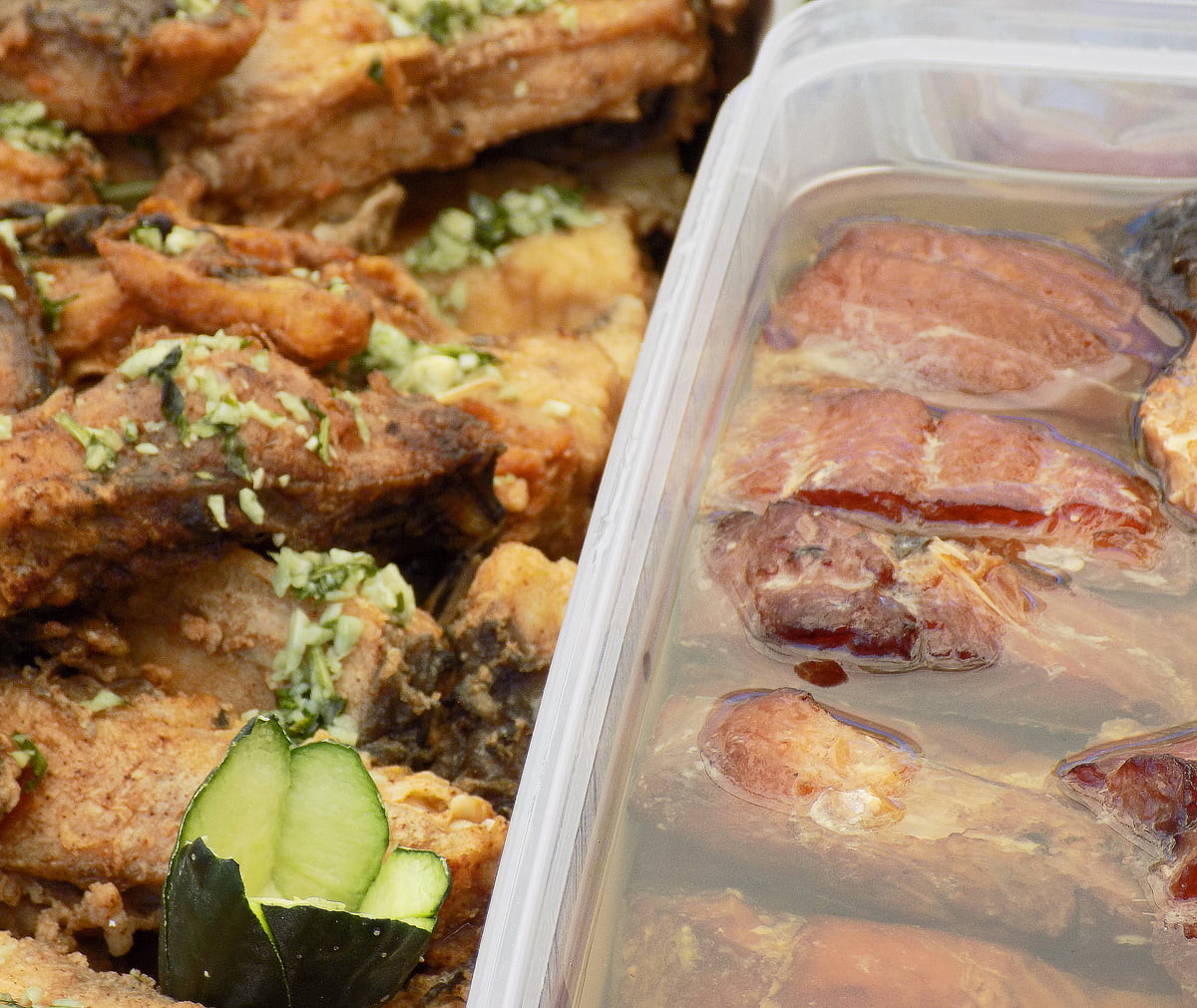
Lake Skadar carp fried with garlic and parsley next to a tray of marinated carp, at the Carp Day festival in Plavnica
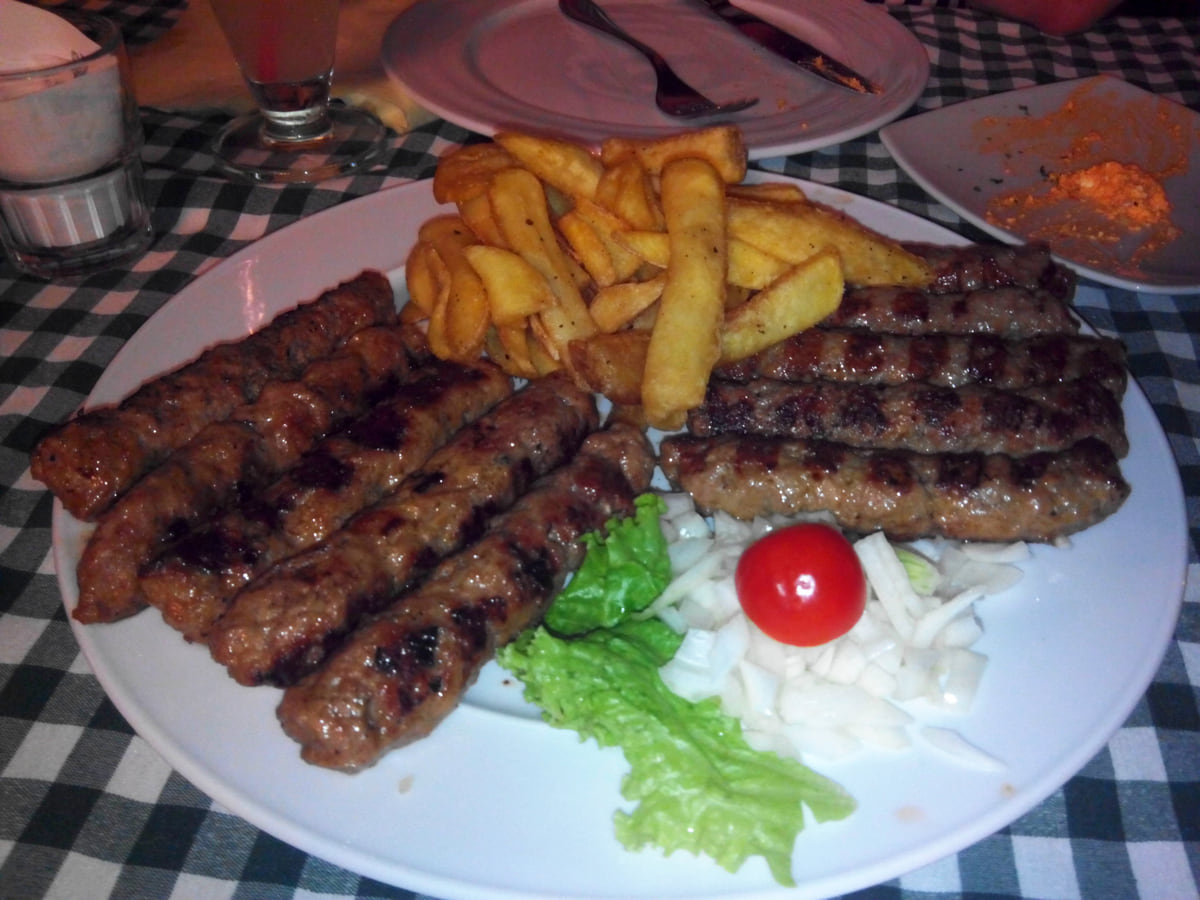
A plate of ćevapi with chips, chopped onion, lettuce and tomato on a checked tablecloth at a restaurant in Budva
What to eat in Montenegro, by area
| Area | Dishes and produce | Source |
|---|---|---|
| Coast and Bar | Fish, olive oil and olives, priganice with honey, japraci, dolma, raštan, pies, halva, pomegranates | Bar Tourist Organisation |
| Lake Skadar | Smoked carp, carp baked with plums, fried or smoked bleak, eel on rice | Montenegro National Tourist Organisation |
| Njeguši and Lovćen | Njeguški pršut, Njeguši sausage, smoked Njeguši cheese | Montenegro National Tourist Organisation |
| Kolašin and Bjelasica | Lisnati cheese, kajmak, kačamak, jardum, honey | Montenegro National Tourist Organisation |
| Pljevlja and the north | Aged Pljevlja cheese, lamb and veal | Montenegro National Tourist Organisation |
| Ulcinj | Olives, olive oil, dried figs, oranges, sudžuk | Ulcinj Tourist Organisation |
Montenegro National Tourist Organisation, flavours and food routes; Bar and Ulcinj tourist boards; checked on 11-10-2026.
Test yourself
True or false?
0/3 Pick before you peek.
-
Njeguši prosciutto is cured at sea level.
See the answer
False. The national tourist board places production at 500 to 1,500 metres, where sea air meets mountain air.
-
Bleak is a small fish found in Lake Skadar.
See the answer
True. It's endemic to the lake, according to the national tourist board, and eaten fried or dried and smoked.
-
Medovina is a plum brandy.
See the answer
False. It's mead, a fermented honey drink, which the national tourist board calls a source of Montenegrin pride.
What to see
What to see in Food
0 of 278 Montenegro guides
Your next stamp
- Where to eat
- Njeguši prosciutto
- Montenegro and Albania
- Wine
- Activities
- Ten-day itinerary
- Njeguši
- Lake Skadar
- Aman Sveti Stefan
- Budva Old Town
- Haj-Nehaj
- Kotor
- Lučice Beach
- Montenegro's coast
- Peaks of the Balkans
- Porto Montenegro
- Sea Dance Festival
- Splendid Conference & Spa Resort
- Stari Bar
- Ulcinj Old Town
- Bay of Kotor
- Budva Riviera
- Heroj submarine
- Iberostar Bellevue
- Independence Day
- Old olive tree of Mirovica
- Tivat
- Velika plaža
- Ada Bojana
- Beaches in Budva
- Eurostars Queen of Montenegro
- Herceg Novi
- Kotor Old Town
- Mount Rumija
- Igalo
- Kotor city walls
- Mogren Beach
- Montenegro Beach Resort
- Svač
- Vrmac
- Hiking
- Jaz Beach
- Kanli kula
- Luštica peninsula
- St Tryphon Cathedral
- Ulcinj salt pans
- Forte Mare
- Gornja Lastva
- Maritime Museum, Kotor
- Slovenska Beach
- Drobni Pijesak Beach
- Kotor viewpoints
- Mamula
- Žanjic beach
- Kotor cruise port
- Orjen
- Plavi horizonti beach
- Sveti Nikola Island
- Blue Cave
- Restaurants in Budva
- Restaurants in Kotor
- Canyoning
- Hotels
- Perast
- Sutomore
- Sveti Stefan
- Čanj
- Luxury hotels
- Our Lady of the Rocks
- Pržno
- Things to do
- All-inclusive hotels
- Bar Riviera
- Bečići
- Hotel Palma
- St George island
- Dobrota
- Hladna uvala
- Most beautiful places
- Petrovac
- Crvena stijena
- Prčanj
- Prettiest villages
- Cycling
- Risan
- UNESCO sites
- Heritage Grand Perast
- Map
- Hyatt Regency Kotor Bay
- Where is it?
- Regions
- Cities
- Beaches in Bar
- Budva
- Central Montenegro
- Hotels in Budva
- Hotels in Kotor
- Iberostar Waves Herceg Novi
- Kitesurfing
- The name
- Beaches in Ulcinj
- Flag
- Hotels in Perast
- Palmon Bay Hotel & Spa
- Podgorica
- Cathedral of the Resurrection
- One&Only Portonovi
- Population
- Sandy beaches
- Azul Beach Resort Montenegro
- Naturist beaches
- Size
- Stara Varoš
- Doclea
- Language
- Mimosa Festival
- Medun
- Religion
- Zipline
- Currency
- Museums in Podgorica
- Dajbabe Monastery
- EU membership
- History
- Restaurants in Podgorica
- Hotels in Podgorica
- Public holidays
- Avala Resort & Villas
- Bar
- Beaches in Kotor
- Birdwatching
- Hotels in Ulcinj
- Kotor carnival
- Time zone
- Tivat beaches
- Tuzi
- Boka Night
- Dukley Hotel & Resort
- Facts
- Hotels in Tivat
- Zeta
- Caves
- Herceg Novi beaches
- National parks
- Šipčanik
- Hotels in Herceg Novi
- Monasteries
- Fortresses
- Fly fishing
- Museums
- Canyons and waterfalls
- Lakes
- Mountains
- Montenegro and Croatia
- Beaches
- Boat trips
- Cetinje
- Nightlife
- Ulcinj
- Weather
- Best time to visit
- Cetinje Monastery
- Kayaking
- Montenegro and the Balkans
- How to get there
- In summer
- King Nikola's Palace
- Sailing
- Biljarda
- Flights
- In winter
- Airports
- Museums in Cetinje
- New Year's Eve
- Lovćen
- Paragliding
- Tivat Airport
- Njegoš Mausoleum
- Podgorica Airport
- Dubrovnik to Kotor
- Kotor serpentine
- Belgrade to Montenegro
- Ferry to Italy
- Border crossings
- In January
- Lipa Cave
- Where to stay
- In February
- Kamenari-Lepetane ferry
- Pavlova strana
- Getting around
- In March
- Rijeka Crnojevića
- In April
- Trains
- Buses
- In May
- Car hire
- In June
- Driving
- In July
- In August
- Taxis
- Distances
- In September
- In October
- Road trip
- In November
- Scenic drives
- In December
- Kotor cable car
- Virpazar
- Budva to Kotor
- Godinje
- Podgorica to Kotor
- Vranjina
- Besac fortress
- Prices and budget
- On a budget
- Žabljak Crnojevića
- Danilovgrad
- Entry requirements
- Ostrog Monastery
- Tourist registration
- Customs
- Nikšić
- Crvena Stijena cave
- Safety
- Events
- Healthcare
- Northern Montenegro
- Mobile and roaming
- Žabljak
- Durmitor
- Plugs
- Black Lake
- With kids
- Bobotov Kuk
- Holidays
- Day trips
- Stećci tombstones
- Hotels in Žabljak
- Three-day itinerary
- Five-day itinerary
- Skiing in Montenegro
- One-week itinerary
- Skiing in Žabljak
- Šavnik
- Nevidio Canyon
- Tara Canyon
- Tara rafting
- Đurđevića Tara Bridge
- Plužine
- Lake Piva
- Piva Monastery
- Mojkovac
- Brskovo
- Pljevlja
- Husein Pasha Mosque
- Kolašin
- Hotels in Kolašin
- Skiing in Kolašin
- Biogradska Gora National Park
- Komovi
- Morača Monastery
- Morača Canyon
- Bijelo Polje
- Đalovića Cave
- Berane
- Andrijevica
- Petnjica
- Rožaje
- Plav
- Lake Plav
- Gusinje
- Vusanje
- Prokletije National Park
Frequently asked questions
What is traditional Montenegrin food?
Njeguši prosciutto, lamb cooked in milk or under the sač, smoked carp and bleak from Lake Skadar, cheeses such as lisnati, Njeguši and Pljevlja, kajmak and kačamak. On the coast, fish and olive oil.
What is the national dish of Montenegro?
I haven't found one officially declared. If I had to name the most representative, it would be Njeguški pršut, which the national tourist board lists first among the country's cured meats.
What is kačamak?
A hearty mountain dish made from potato or maize with several cheeses and kajmak, a thick clotted cream. The national tourist board presents it as traditional village and katun food.
What do people drink in Montenegro?
Vranac red wine, home-made rakija and medovina, a honey mead. The national tourist board also recommends Piva mead and Crmnica wine.
Is Montenegrin food like Croatian or Italian food?
On the coast you'll find plenty of fish, olive oil and dishes that will feel familiar from elsewhere on the Adriatic. Inland it's a different story, with cured meats, mountain cheeses, lamb and freshwater fish.
By
Tourism graduate with a master’s in Tourism Management and Planning from the University of Málaga, who has travelled across Europe. He writes every guide from official sources and his own judgement.
Published on . Facts checked on .
Sources
Some links in this guide are affiliate links: if you book through them, the site earns a commission at no extra cost to you. Affiliate disclosure
Photos: Haydn Blackey from Cardiff, Wales (CC BY-SA 2.0); Milica Buha (CC BY-SA 4.0); Spacekid (CC0 1.0), via Wikimedia Commons.