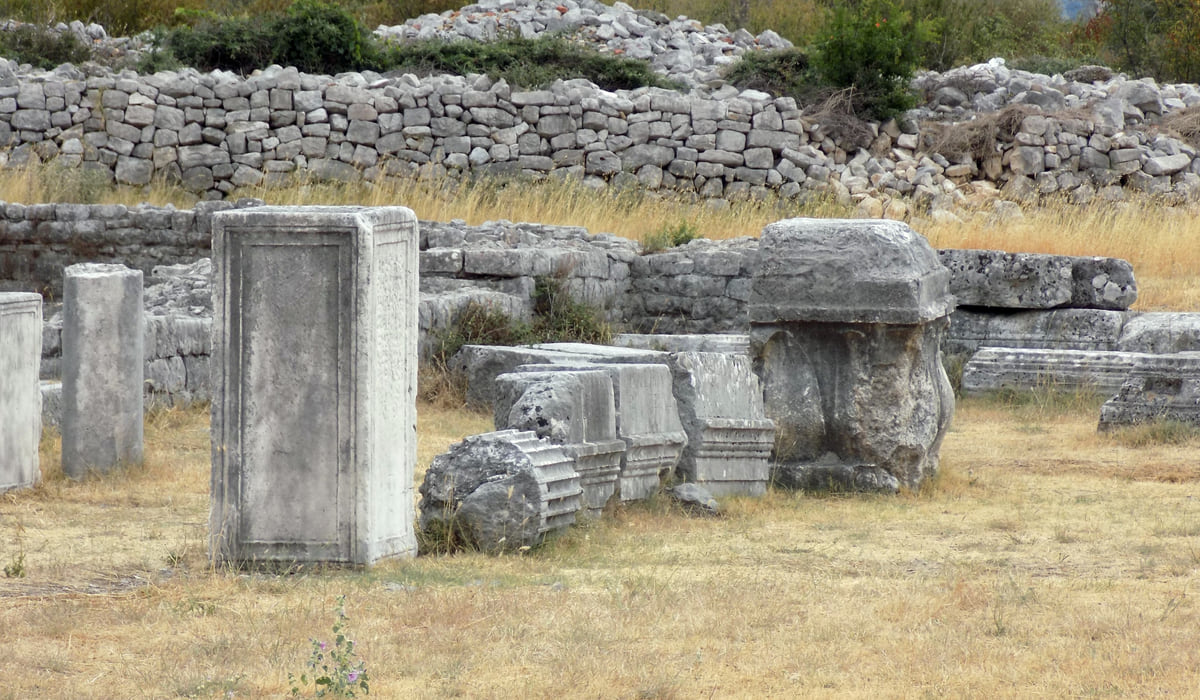
The Roman site of Duklja
Doclea, the Roman ruins on Podgorica's doorstep
Doclea, Duklja in Montenegrin, is a Roman city founded in the first decade of the 1st century AD on a plateau between the Morača, the Zeta and the Širijana, about 4 km from central Podgorica. It had temples, baths and a triumphal arch, and from the 4th century a Christian quarter with an episcopal basilica. The Podgorica Cup, now in the Hermitage, came from here.
In 30 seconds
Full read: 3 min
- Doclea (Duklja) is a 1st-century Roman city about 4 km from Podgorica.
- It lies between the Morača, the Zeta and the Širijana rivers.
- It had temples, baths, a triumphal arch and an episcopal basilica.
- The 4th-century Podgorica Cup came from here and is now in the Hermitage.
Doclea suits people who enjoy rebuilding a whole city in their heads from low walls and fallen columns. I'd go first thing or late in the day, because there's no shade on the plateau, and then see the finds in the City Museum.

Before you go
What I would keep in mind
-
01 Most beautiful
The Podgorica Cup
The find that put Doclea on the archaeological map is a 4th-century glass cup engraved with Old and New Testament scenes. It's kept at the Hermitage in St Petersburg.
-
02 My tip
Bring water and a hat
The site sits on an open plain by the rivers. Podgorica averaged 30.9 °C in July 2024, so a midday visit in summer is hard going.
-
03 Getting there
A short hop from town
The Podgorica tourist board puts the ruins 4 km from the centre; the National Tourism Organisation says 3 km. Either way it's a quick taxi ride or an easy cycle.
Podgorica -
04 Most beautiful
Water from the Cijevna
A Roman aqueduct carried water from the Cijevna river to Doclea. The Tuzi tourist board says stretches of the channel cut into the rock can still be seen at Dinoša and Omerbožaj.
Tuzi
I have a soft spot for Roman sites that never make the top-ten lists, and Doclea is one of them. It sits on the edge of Podgorica, on an open plateau where three rivers meet, and what you walk among are low walls, column bases and blocks of stone in the grass. It isn’t Pompeii, and nobody should sell it to you as such. But it was a proper city with temples, baths and a governor’s palace, and it gave its name to the first medieval state in what is now Montenegro.
A Roman town where three rivers meet
The Tourist Organisation of Podgorica places the remains four kilometres from the centre, on a broad plateau between the Morača, the Zeta and the Širijana, and dates the oldest of them to the first decade of the 1st century AD. The National Tourism Organisation talks about three kilometres and the meeting point of the Zeta and the Morača, and adds the story that the emperor Diocletian was born here. I’d file that under legend, a nice one, with nothing to back it up.
The same national body sketches the town you have to picture over the ruins. A prosperous market with good infrastructure, temples, baths, a triumphal arch put up to celebrate military victories, and a palace for the Roman governors. Walk the site with that list in your head and the scattered stones start to make sense.
Christians, a basilica and a famous glass cup
From the 4th century a Christian quarter grew up on the eastern side of the city, with churches and a large episcopal basilica. The cemeteries have produced pottery and glass vessels, jewellery, tools, weapons and coins, and some of that material forms part of the permanent display at the City Museum in Podgorica. The object that made Doclea famous, though, is the Podgorica Cup, a 4th-century glass vessel engraved with scenes from the Old and New Testaments, which the National Tourism Organisation calls a masterpiece of early Christian art. You’ll have to go to the Hermitage in St Petersburg to see it.
Digging started at the end of the 19th century and, the tourist board says, has carried on ever since. That’s one reason the site looks a little different from one visit to the next.
To sleep close to everything, search places to stay in Podgorica on Expedia and filter by area before price.
Water from the Cijevna
Roman Doclea needed water, and it came from the east. The Tuzi tourist board describes an aqueduct that linked the Cijevna river with the city, with remains of the channel cut into solid rock still visible near the villages of Dinoša and Omerbožaj, a little over a metre high. If you’re heading out to the river and its waterfalls in Tuzi, it’s worth knowing that the same water once supplied these baths.
From Doclea to Duklja
The name has travelled further than the stones. Duklja is the local form of Doclea, and the National Tourism Organisation explains that in the late 10th century, under Prince Vladimir, the state of Duklja took shape, was renamed Zeta in the 11th century and became a kingdom under the Vojislavljević dynasty. If that thread interests you, pick it up in the history of Montenegro.
If you are short on time, see the best tours in Doclea and pick one that fits your day.
Planning a visit
Doclea fits neatly into a morning on the outskirts of Podgorica. Neither the opening hours nor an entry fee appear on any official site, so I leave both blank rather than guess. What I can say is that the plateau has no shade and the valley gets very hot, with a July average of 30.9 °C in Podgorica in 2024 according to MONSTAT. Take water, closed shoes and go early or late.
To round off a day of Roman and medieval sites, I’d carry on north-east to Medun, the Illyrian town of Meteon about 12 km from the capital, or head back into the centre to see what’s left of the Ottoman town in Podgorica old town.
To sleep close to everything, search places to stay in Podgorica on Booking.com and filter by area before price.
Podgorica's Millennium Bridge over the River Morača, with its white pylon and cables, beside a footbridge
Doclea through time
| Period | What happened | Source |
|---|---|---|
| First decade of the 1st century AD | Oldest remains of the city | Tourist Organisation of Podgorica |
| 4th century | Christian quarter to the east, churches and a large episcopal basilica | Tourist Organisation of Podgorica |
| 4th century | The Podgorica Cup, now in the Hermitage | National Tourism Organisation |
| Late 10th century | The state of Duklja under Prince Vladimir | National Tourism Organisation |
| Late 19th century | Excavations begin and carry on today | Tourist Organisation of Podgorica |
Checked on 10-10-2026. The official websites don't publish opening hours or an entry price.
Test yourself
True or false?
0/3 Pick before you peek.
-
The Podgorica Cup is displayed in Podgorica.
See the answer
False. It's in the Hermitage in St Petersburg. Other grave goods from Doclea are on show in Podgorica's City Museum.
-
Doclea had a Christian quarter with an episcopal basilica.
See the answer
True. From the 4th century, on the eastern side of the city, according to the Tourist Organisation of Podgorica.
-
Excavations at Doclea only started in 2010.
See the answer
False. They began at the end of the 19th century and are still going on.
Map
Where Doclea is
The Adriatic coast runs from Herceg Novi to Ulcinj; the centre holds Podgorica, Cetinje and Lake Skadar, and the north, Durmitor and the Tara Canyon. Every number opens its guide.
 1Podgorica 2Cathedral of the Resurrection 3Stara Varoš 4Doclea 5Medun 6Museums in Podgorica 7Dajbabe Monastery 8Morača Canyon
 Map data © OpenStreetMap contributors (ODbL)
- 1PodgoricaCapital of Montenegro
- 2Cathedral of the ResurrectionPodgorica's Orthodox cathedral
- 3Stara VarošPodgorica's old quarter
- 4DocleaThe Roman site of Duklja
- 5MedunArchaeological site and museum near Podgorica
- 6Museums in PodgoricaMuseums in Montenegro's capital
- 7Dajbabe MonasteryPodgorica's cave monastery
- 8Morača CanyonMorača river, between Kolašin and Podgorica
0 of 278 Montenegro guides
Your next stamp
- Podgorica
- Cities
- Restaurants in Podgorica
- Berane
- Central Montenegro
- History
- Hotels in Podgorica
- Monasteries
- Aman Sveti Stefan
- Budva Old Town
- Haj-Nehaj
- Kotor
- Lučice Beach
- Montenegro's coast
- Peaks of the Balkans
- Porto Montenegro
- Sea Dance Festival
- Splendid Conference & Spa Resort
- Stari Bar
- Ulcinj Old Town
- Bay of Kotor
- Budva Riviera
- Heroj submarine
- Iberostar Bellevue
- Independence Day
- Old olive tree of Mirovica
- Tivat
- Velika plaža
- Ada Bojana
- Beaches in Budva
- Eurostars Queen of Montenegro
- Herceg Novi
- Kotor Old Town
- Mount Rumija
- Igalo
- Kotor city walls
- Mogren Beach
- Montenegro Beach Resort
- Svač
- Vrmac
- Hiking
- Jaz Beach
- Kanli kula
- Luštica peninsula
- St Tryphon Cathedral
- Ulcinj salt pans
- Forte Mare
- Gornja Lastva
- Maritime Museum, Kotor
- Slovenska Beach
- Drobni Pijesak Beach
- Kotor viewpoints
- Mamula
- Žanjic beach
- Kotor cruise port
- Orjen
- Plavi horizonti beach
- Sveti Nikola Island
- Blue Cave
- Restaurants in Budva
- Restaurants in Kotor
- Canyoning
- Hotels
- Perast
- Sutomore
- Sveti Stefan
- Čanj
- Luxury hotels
- Our Lady of the Rocks
- Pržno
- Things to do
- Activities
- All-inclusive hotels
- Bar Riviera
- Bečići
- Hotel Palma
- St George island
- Dobrota
- Hladna uvala
- Most beautiful places
- Petrovac
- Crvena stijena
- Prčanj
- Prettiest villages
- Cycling
- Risan
- UNESCO sites
- Heritage Grand Perast
- Map
- Hyatt Regency Kotor Bay
- Where is it?
- Regions
- Beaches in Bar
- Budva
- Hotels in Budva
- Hotels in Kotor
- Iberostar Waves Herceg Novi
- Kitesurfing
- The name
- Beaches in Ulcinj
- Flag
- Hotels in Perast
- Palmon Bay Hotel & Spa
- Cathedral of the Resurrection
- One&Only Portonovi
- Population
- Sandy beaches
- Azul Beach Resort Montenegro
- Naturist beaches
- Size
- Stara Varoš
- Language
- Mimosa Festival
- Medun
- Religion
- Zipline
- Currency
- Museums in Podgorica
- Dajbabe Monastery
- EU membership
- Public holidays
- Avala Resort & Villas
- Bar
- Beaches in Kotor
- Birdwatching
- Hotels in Ulcinj
- Kotor carnival
- Time zone
- Tivat beaches
- Tuzi
- Boka Night
- Dukley Hotel & Resort
- Facts
- Hotels in Tivat
- Zeta
- Caves
- Herceg Novi beaches
- National parks
- Šipčanik
- Hotels in Herceg Novi
- Fortresses
- Fly fishing
- Museums
- Canyons and waterfalls
- Lakes
- Mountains
- Montenegro and Croatia
- Beaches
- Boat trips
- Cetinje
- Montenegro and Albania
- Nightlife
- Ulcinj
- Weather
- Best time to visit
- Cetinje Monastery
- Kayaking
- Montenegro and the Balkans
- How to get there
- In summer
- King Nikola's Palace
- Sailing
- Biljarda
- Flights
- In winter
- Airports
- Museums in Cetinje
- New Year's Eve
- Lovćen
- Paragliding
- Tivat Airport
- Njegoš Mausoleum
- Podgorica Airport
- Dubrovnik to Kotor
- Kotor serpentine
- Belgrade to Montenegro
- Njeguši
- Ferry to Italy
- Njeguši prosciutto
- Border crossings
- In January
- Lipa Cave
- Where to stay
- In February
- Kamenari-Lepetane ferry
- Pavlova strana
- Getting around
- In March
- Rijeka Crnojevića
- In April
- Trains
- Buses
- In May
- Car hire
- In June
- Driving
- In July
- In August
- Taxis
- Distances
- In September
- In October
- Road trip
- Food
- In November
- Lake Skadar
- Scenic drives
- In December
- Kotor cable car
- Virpazar
- Where to eat
- Budva to Kotor
- Godinje
- Wine
- Podgorica to Kotor
- Vranjina
- Besac fortress
- Prices and budget
- On a budget
- Žabljak Crnojevića
- Danilovgrad
- Entry requirements
- Ostrog Monastery
- Tourist registration
- Customs
- Nikšić
- Crvena Stijena cave
- Safety
- Events
- Healthcare
- Northern Montenegro
- Mobile and roaming
- Žabljak
- Durmitor
- Plugs
- Black Lake
- With kids
- Bobotov Kuk
- Holidays
- Day trips
- Stećci tombstones
- Hotels in Žabljak
- Three-day itinerary
- Five-day itinerary
- Skiing in Montenegro
- One-week itinerary
- Skiing in Žabljak
- Šavnik
- Ten-day itinerary
- Nevidio Canyon
- Tara Canyon
- Tara rafting
- Đurđevića Tara Bridge
- Plužine
- Lake Piva
- Piva Monastery
- Mojkovac
- Brskovo
- Pljevlja
- Husein Pasha Mosque
- Kolašin
- Hotels in Kolašin
- Skiing in Kolašin
- Biogradska Gora National Park
- Komovi
- Morača Monastery
- Morača Canyon
- Bijelo Polje
- Đalovića Cave
- Andrijevica
- Petnjica
- Rožaje
- Plav
- Lake Plav
- Gusinje
- Vusanje
- Prokletije National Park
Frequently asked questions
What is Doclea in Montenegro?
A Roman city founded in the 1st century AD next to present-day Podgorica, where the Zeta meets the Morača. Today it's an archaeological site with remains of temples, baths and a basilica.
How far are the Doclea ruins from Podgorica?
About 4 km from the city centre, on a plateau between the Morača, the Zeta and the Širijana, according to the Tourist Organisation of Podgorica. The National Tourism Organisation gives 3 km.
Was Diocletian born in Doclea?
That's the legend, and the National Tourism Organisation repeats it. There's no proof, so treat it as tradition rather than history.
Where can I see finds from Doclea?
Part of the grave goods, including pottery, glass, jewellery, tools, weapons and coins, is on permanent display at the City Museum in Podgorica. The Podgorica Cup itself is in the Hermitage.
Is Doclea the same as Duklja?
Yes. Duklja is the local form of Doclea, and it's also the name of the first medieval state in the area, which the National Tourism Organisation dates to the late 10th century.
By
Tourism graduate with a master’s in Tourism Management and Planning from the University of Málaga, who has travelled across Europe. He writes every guide from official sources and his own judgement.
Published on . Facts checked on .
Sources
Some links in this guide are affiliate links: if you book through them, the site earns a commission at no extra cost to you. Affiliate disclosure
Photos: BuhaM (CC BY-SA 4.0); Desemeus (CC BY-SA 4.0), via Wikimedia Commons.