Montenegro's middle region
Central Montenegro: the capital, the lake and the holy mountain
Central Montenegro is what MONSTAT calls the Middle region: Podgorica, Cetinje, Danilovgrad, Nikšić, Tuzi and Zeta. It had 307,371 residents in the 2023 census, almost half the country, and holds the capital, the old royal capital, Lake Skadar, Lovćen National Park and Ostrog Monastery.
In 30 seconds
Full read: 3 min
- Central Montenegro is six municipalities: Podgorica, Cetinje, Danilovgrad, Nikšić, Tuzi and Zeta.
- Almost half the country lives here: 307,371 people in the 2023 census.
- It has two national parks, Lovćen (€3) and Lake Skadar (€5).
- Podgorica is the practical base, with the coast about an hour away.
If you fly into Podgorica rather than Tivat, don't rush straight to the coast. Give the centre two days from a base in Podgorica or Cetinje: Lake Skadar and Ostrog are the two inland sights I'd never skip.

Before you go
What I would keep in mind
-
01 Most beautiful
The Balkans' largest lake
Lake Skadar covers 369.7 km² according to MONSTAT and has been a national park since 1983. The National Tourism Organisation counts around 280 bird species.
Lake Skadar -
02 To save money
Two national parks for €8
An adult day ticket for Lovćen National Park costs €3 and for Lake Skadar €5, on the official tariffs of the National Parks of Montenegro.
Lovćen National Park -
03 Getting there
The train from Podgorica to Nikšić
ZPCG runs five trains a day between Podgorica and Nikšić, taking 1 h 06 and stopping at Danilovgrad. A second-class ticket is €3.20.
Nikšić -
04 My tip
Beat the heat at Ostrog
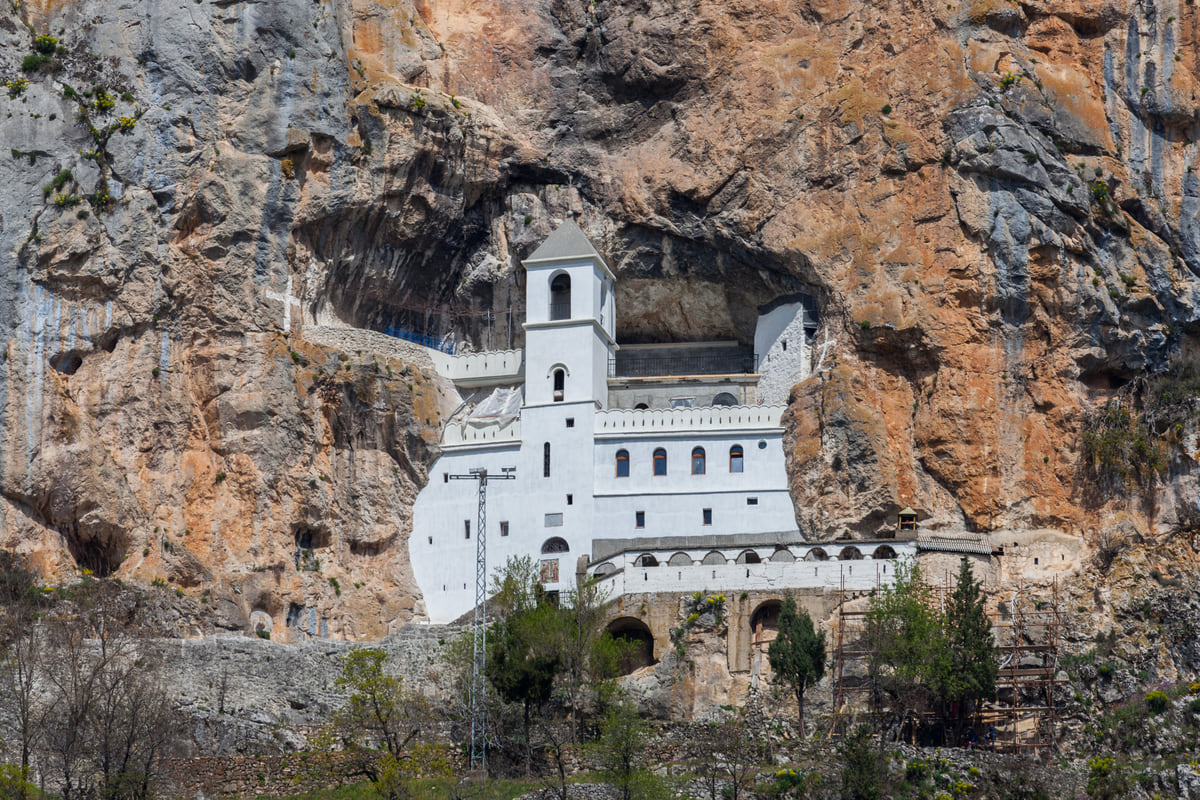
Ostrog sits at around 900 metres above the Zeta valley, and pilgrims walk the last 3 km through the forest. In summer, set off early.
Ostrog Monastery -
05 Getting there
The whole country on one page
Podgorica is the capital and Cetinje the old royal capital, both in this region. To fit it together with the coast and the north, currency and entry rules included, start with the Montenegro guide.
Montenegro travel guide -
06 Most beautiful
The municipality by Albania
Tuzi has 12,979 people over 242 km², with the Illyrian hillfort of Samobor, traces of a Roman aqueduct and the Šipčanik wine cellar.
Tuzi
What I would book
- Places to stayBooking.com Stay in Podgorica for the centre It has more hotels than anywhere else in the region and the best train, coach and air links.
- Tours and ticketsGetYourGuide A boat trip on Lake Skadar The lake makes sense from the water, and trips from Virpazar are the easiest way to see it.
Most British visitors land at Tivat, head for the Bay of Kotor and Budva, and never see the half of Montenegro that sits behind the mountains. I mean half quite literally, because the centre is home to 307,371 of the 623,633 people counted in the December 2023 census. It has the capital, the old royal capital, the largest lake in the Balkans and the country’s most visited monastery. If you’re flying into Podgorica, or you can spare two or three days between the coast and the north, this is where I’d spend them.
What counts as central Montenegro
MONSTAT, the national statistics office, splits the country into three regions, the coast, the centre and the north. They aren’t counties with their own councils, just a way of grouping figures. The Middle region is six municipalities, namely Podgorica, the capital, Cetinje, the old royal capital, and Danilovgrad, Nikšić, Tuzi and Zeta. Add up MONSTAT’s areas and you get about 4,851 km², plus the Montenegrin share of Lake Skadar, which the official table leaves outside any municipality.
The split is lopsided. Podgorica has 179,505 residents and Nikšić 65,705, while Tuzi, the smallest, has 12,979. Nikšić is also the largest municipality in the whole country at 2,087 km². Tourism is even more concentrated. Of the 248,262 arrivals the region recorded in 2024, 204,548 went to Podgorica.
Podgorica and Cetinje, two capitals half an hour apart
Podgorica is a young, flat capital where the Ribnica meets the Morača, with an Ottoman quarter, Stara Varoš, the country’s newest Orthodox cathedral and the Roman ruins of Doclea a few kilometres out. I use it mainly as a base, since it has the broadest choice of hotels in the centre, the airport, the railway station and coaches to everywhere.
About 30 km away by road is Cetinje, which the Constitution calls the “Old Royal Capital”. The Petrović rulers lived here, the foreign legations sat here, and the National Museum is still spread across several of its buildings. If I could only wander around one of the two, I’d pick Cetinje.
To sleep close to everything, search places to stay in Podgorica on Expedia and filter by area before price.
Lake Skadar and Lovćen, the two national parks
Lake Skadar was declared a national park in 1983. MONSTAT puts it at 369.7 km² and just 6 metres above sea level, and the National Tourism Organisation counts around 280 bird species and calls it the Balkans’ largest lake. A day ticket is €5, and boat trips start from Virpazar, Vranjina, Plavnica and Rijeka Crnojevića.
Lovćen National Park, between Cetinje and the Bay of Kotor, is smaller at 6,220 hectares, but the view from Njegoš’s mausoleum on Jezerski vrh is the widest in the country. Entry is €3. For €8 a head you get both parks, which between them sum up the centre, water and limestone.
Ostrog and Nikšić, further inland
You can spot Ostrog Monastery from miles away, white and wedged into the cliff at around 900 metres above the Zeta valley. The National Tourism Organisation calls it one of the most visited sites in the Orthodox world, and pilgrims climb the last 3 km on foot through the forest. It lies near Danilovgrad, halfway between Podgorica and Nikšić.
Nikšić is Montenegro’s second city and the gateway to Durmitor. Near the village of Petrovići is the cave of Crvena stijena, a 180,000-year-old site with 31 layers of occupation. ZPCG trains run between Podgorica and Nikšić five times a day, 1 h 06 for €3.20 in second class, with a stop at Danilovgrad.
To sleep close to everything, search places to stay in Podgorica on Booking.com and filter by area before price.
When to go and how to get around
The centre works all year round, and the National Tourism Organisation recommends Podgorica and Cetinje in every season. What you do need to plan for is the heat in the valley. In 2024 Podgorica averaged 30.9 °C in July and hit 41.1 °C, according to Hydrometeorological Institute figures published by MONSTAT. Nikšić, higher up, averaged 25.1 °C in July. Bear in mind that Montenegro drives on the right, so the mountain hairpins come at you from the opposite side to home.
A hire car is the sensible option. Distances are short, but the lake, Lovćen and Ostrog are all a long way from a station. Without a car, the train gets you to Danilovgrad and Nikšić and private coaches link the towns. And if real mountains are what you’re after, carry on from Nikšić or up the Morača canyon into northern Montenegro, which is a different region and a different trip.
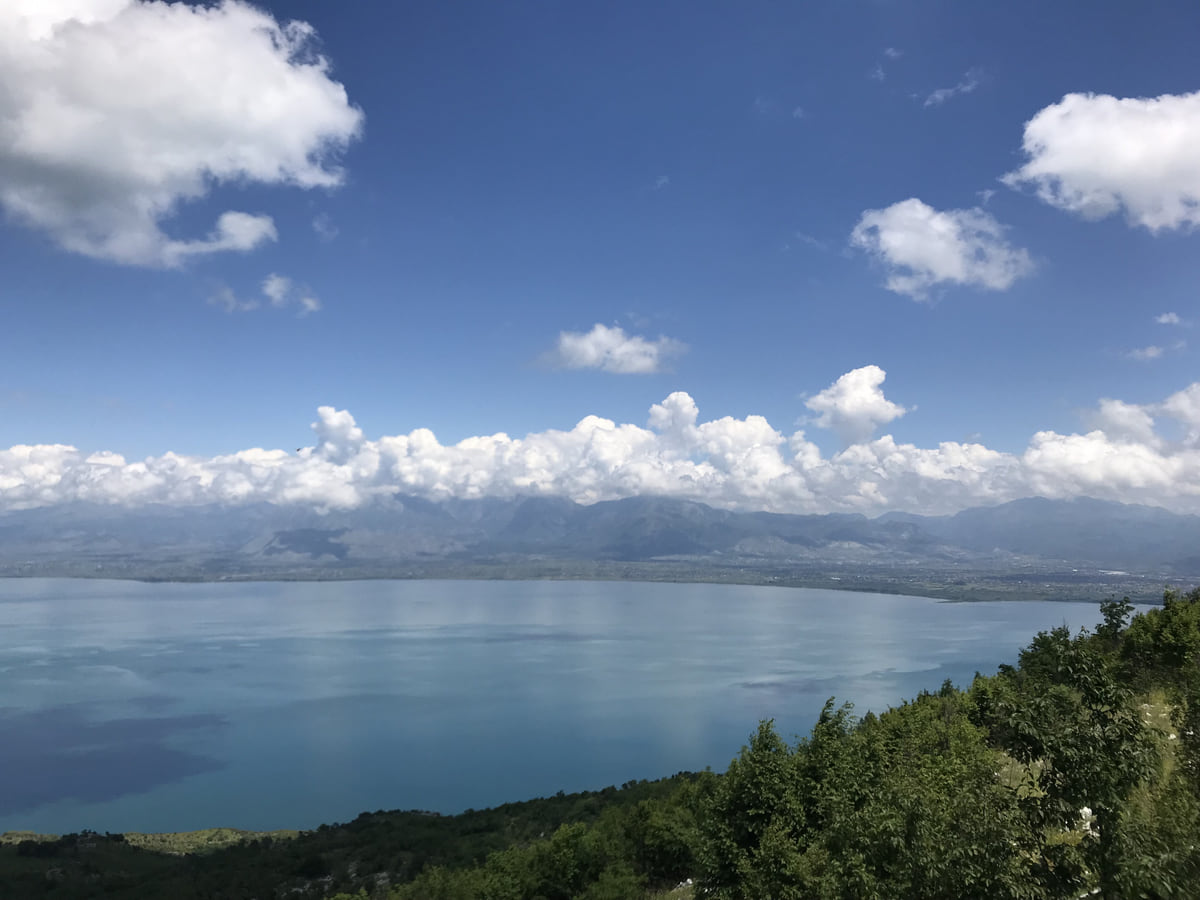
Lake Skadar from the Montenegrin shore, its blue water stretching to the mountains with white clouds on the horizon
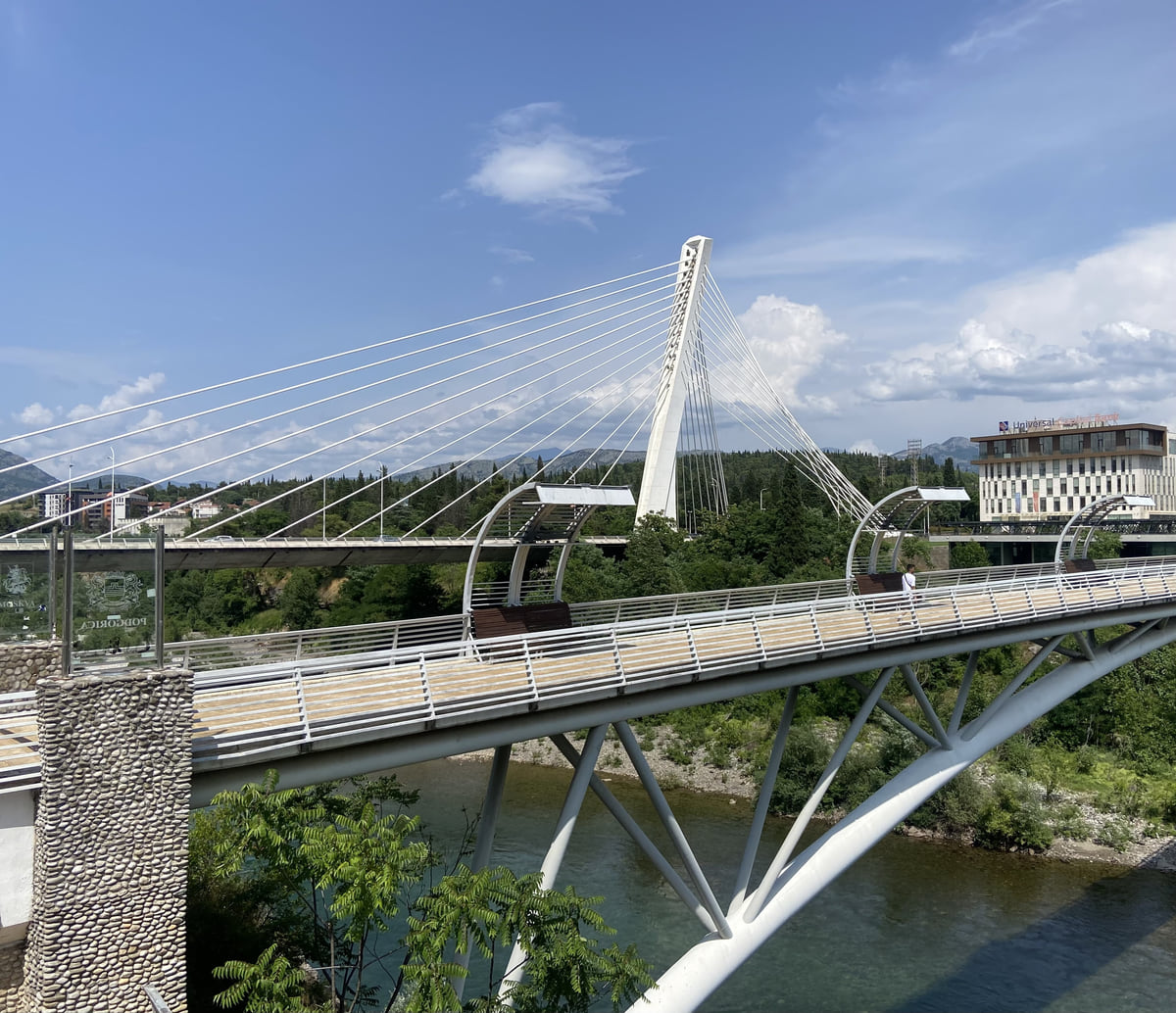
Podgorica's Millennium Bridge over the River Morača, with its white pylon and cables, beside a footbridge
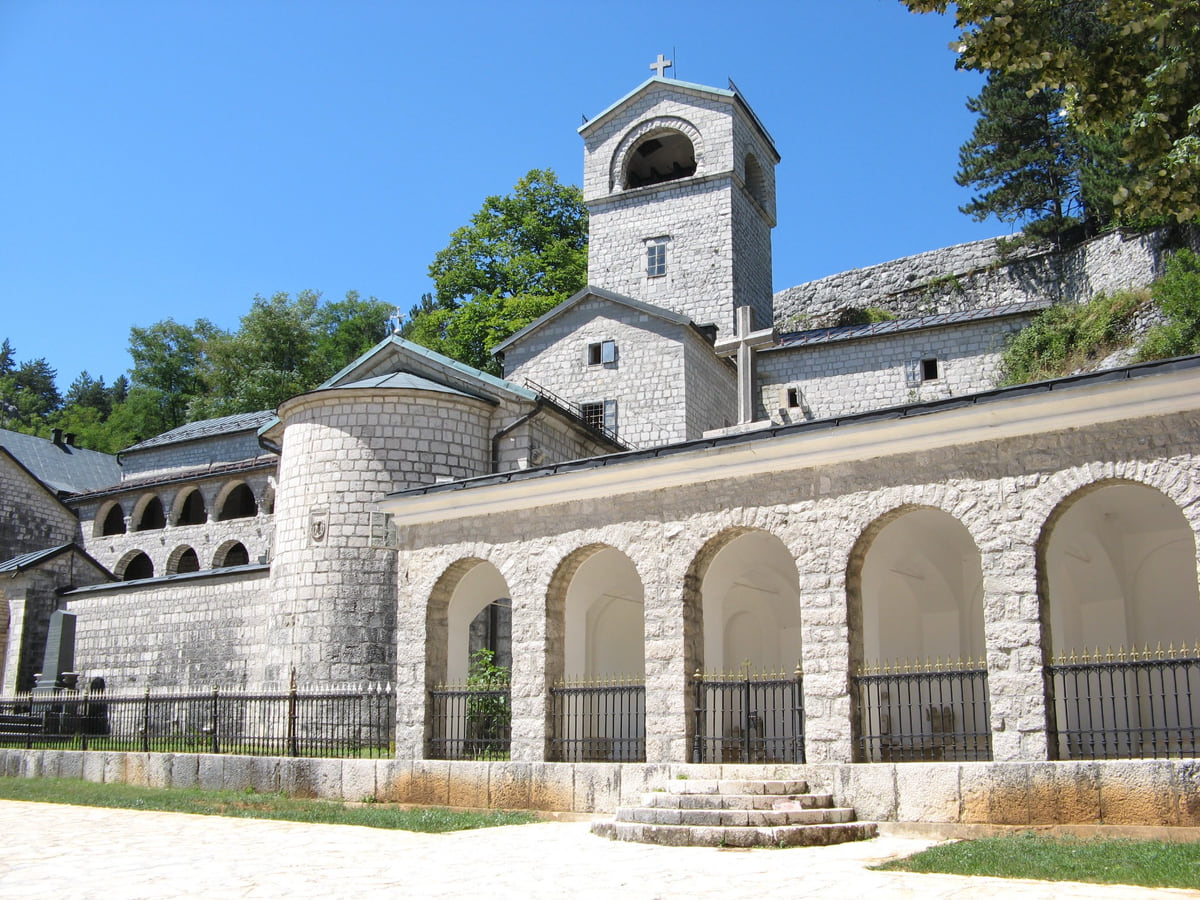
Cetinje Monastery in pale stone, with its bell tower and arcaded gallery along the front under a blue sky
The six municipalities of central Montenegro
| Municipality | Population 2023 | km² | Arrivals 2024 |
|---|---|---|---|
| Podgorica (capital) | 179,505 | 997 | 204,548 |
| Nikšić | 65,705 | 2,087 | 17,990 |
| Danilovgrad | 18,617 | 475 | 3,379 |
| Zeta | 16,071 | 152 | 3,656 |
| Cetinje (old royal capital) | 14,494 | 898 | 13,058 |
| Tuzi | 12,979 | 242 | 5,631 |
Source: MONSTAT (2023 census, 2025 yearbook and 2024 tourism survey). Areas for Podgorica, Tuzi and Zeta are provisional.
Central Montenegro's weather in 2024
| Station | January | July | Highest | Rainy days |
|---|---|---|---|---|
| Podgorica | 7.8 °C | 30.9 °C | 41.1 °C | 127 |
| Nikšić | 4.0 °C | 25.1 °C | 38.1 °C | 139 |
One year of data (2024) from the Hydrometeorological Institute, published by MONSTAT. These are not long-term averages.
Test yourself
True or false?
0/3 Pick before you peek.
-
Montenegro's regions are provinces with their own government.
See the answer
False. They are statistical regions used by MONSTAT. The country is administered through its 25 municipalities.
-
Nikšić is the largest municipality in Montenegro.
See the answer
True. MONSTAT gives it 2,087 km², more than any other municipality in the country.
-
Entry to Lovćen National Park costs €10.
See the answer
False. It costs €3 per adult per day on the National Parks of Montenegro tariff.
- Residents in 2023
- 307,371
- Municipalities
- 6
- Area of Lake Skadar
- 369.7 km²
- Nikšić, the country's largest municipality
- 2,087 km²
Map
Where Central Montenegro is
The Adriatic coast runs from Herceg Novi to Ulcinj; the centre holds Podgorica, Cetinje and Lake Skadar, and the north, Durmitor and the Tara Canyon. Every number opens its guide.
 1Central Montenegro 2Podgorica 3Tuzi 4Zeta 5Cetinje 6Lake Skadar 7Danilovgrad 8Nikšić
 Map data © OpenStreetMap contributors (ODbL)
- 1Central MontenegroMontenegro's middle region
- 2PodgoricaCapital of Montenegro
- 3TuziMunicipality in central Montenegro
- 4ZetaZeta municipality, centred on Golubovci
- 5CetinjeMontenegro's historic capital
- 6Lake SkadarNational park since 1983
- 7DanilovgradMunicipality in central Montenegro
- 8NikšićMontenegro's second city, in the centre
What to see
What to see in Central Montenegro
0 of 278 Montenegro guides
Your next stamp
- Podgorica
- Cities
- Monasteries
- Five-day itinerary
- Lake Skadar
- Things to do
- Ten-day itinerary
- Aman Sveti Stefan
- Budva Old Town
- Haj-Nehaj
- Kotor
- Lučice Beach
- Montenegro's coast
- Peaks of the Balkans
- Porto Montenegro
- Sea Dance Festival
- Splendid Conference & Spa Resort
- Stari Bar
- Ulcinj Old Town
- Bay of Kotor
- Budva Riviera
- Heroj submarine
- Iberostar Bellevue
- Independence Day
- Old olive tree of Mirovica
- Tivat
- Velika plaža
- Ada Bojana
- Beaches in Budva
- Eurostars Queen of Montenegro
- Herceg Novi
- Kotor Old Town
- Mount Rumija
- Igalo
- Kotor city walls
- Mogren Beach
- Montenegro Beach Resort
- Svač
- Vrmac
- Hiking
- Jaz Beach
- Kanli kula
- Luštica peninsula
- St Tryphon Cathedral
- Ulcinj salt pans
- Forte Mare
- Gornja Lastva
- Maritime Museum, Kotor
- Slovenska Beach
- Drobni Pijesak Beach
- Kotor viewpoints
- Mamula
- Žanjic beach
- Kotor cruise port
- Orjen
- Plavi horizonti beach
- Sveti Nikola Island
- Blue Cave
- Restaurants in Budva
- Restaurants in Kotor
- Canyoning
- Hotels
- Perast
- Sutomore
- Sveti Stefan
- Čanj
- Luxury hotels
- Our Lady of the Rocks
- Pržno
- Activities
- All-inclusive hotels
- Bar Riviera
- Bečići
- Hotel Palma
- St George island
- Dobrota
- Hladna uvala
- Most beautiful places
- Petrovac
- Crvena stijena
- Prčanj
- Prettiest villages
- Cycling
- Risan
- UNESCO sites
- Heritage Grand Perast
- Map
- Hyatt Regency Kotor Bay
- Where is it?
- Regions
- Beaches in Bar
- Budva
- Hotels in Budva
- Hotels in Kotor
- Iberostar Waves Herceg Novi
- Kitesurfing
- The name
- Beaches in Ulcinj
- Flag
- Hotels in Perast
- Palmon Bay Hotel & Spa
- Cathedral of the Resurrection
- One&Only Portonovi
- Population
- Sandy beaches
- Azul Beach Resort Montenegro
- Naturist beaches
- Size
- Stara Varoš
- Doclea
- Language
- Mimosa Festival
- Medun
- Religion
- Zipline
- Currency
- Museums in Podgorica
- Dajbabe Monastery
- EU membership
- History
- Restaurants in Podgorica
- Hotels in Podgorica
- Public holidays
- Avala Resort & Villas
- Bar
- Beaches in Kotor
- Birdwatching
- Hotels in Ulcinj
- Kotor carnival
- Time zone
- Tivat beaches
- Tuzi
- Boka Night
- Dukley Hotel & Resort
- Facts
- Hotels in Tivat
- Zeta
- Caves
- Herceg Novi beaches
- National parks
- Šipčanik
- Hotels in Herceg Novi
- Fortresses
- Fly fishing
- Museums
- Canyons and waterfalls
- Lakes
- Mountains
- Montenegro and Croatia
- Beaches
- Boat trips
- Cetinje
- Montenegro and Albania
- Nightlife
- Ulcinj
- Weather
- Best time to visit
- Cetinje Monastery
- Kayaking
- Montenegro and the Balkans
- How to get there
- In summer
- King Nikola's Palace
- Sailing
- Biljarda
- Flights
- In winter
- Airports
- Museums in Cetinje
- New Year's Eve
- Lovćen
- Paragliding
- Tivat Airport
- Njegoš Mausoleum
- Podgorica Airport
- Dubrovnik to Kotor
- Kotor serpentine
- Belgrade to Montenegro
- Njeguši
- Ferry to Italy
- Njeguši prosciutto
- Border crossings
- In January
- Lipa Cave
- Where to stay
- In February
- Kamenari-Lepetane ferry
- Pavlova strana
- Getting around
- In March
- Rijeka Crnojevića
- In April
- Trains
- Buses
- In May
- Car hire
- In June
- Driving
- In July
- In August
- Taxis
- Distances
- In September
- In October
- Road trip
- Food
- In November
- Scenic drives
- In December
- Kotor cable car
- Virpazar
- Where to eat
- Budva to Kotor
- Godinje
- Wine
- Podgorica to Kotor
- Vranjina
- Besac fortress
- Prices and budget
- On a budget
- Žabljak Crnojevića
- Danilovgrad
- Entry requirements
- Ostrog Monastery
- Tourist registration
- Customs
- Nikšić
- Crvena Stijena cave
- Safety
- Events
- Healthcare
- Northern Montenegro
- Mobile and roaming
- Žabljak
- Durmitor
- Plugs
- Black Lake
- With kids
- Bobotov Kuk
- Holidays
- Day trips
- Stećci tombstones
- Hotels in Žabljak
- Three-day itinerary
- Skiing in Montenegro
- One-week itinerary
- Skiing in Žabljak
- Šavnik
- Nevidio Canyon
- Tara Canyon
- Tara rafting
- Đurđevića Tara Bridge
- Plužine
- Lake Piva
- Piva Monastery
- Mojkovac
- Brskovo
- Pljevlja
- Husein Pasha Mosque
- Kolašin
- Hotels in Kolašin
- Skiing in Kolašin
- Biogradska Gora National Park
- Komovi
- Morača Monastery
- Morača Canyon
- Bijelo Polje
- Đalovića Cave
- Berane
- Andrijevica
- Petnjica
- Rožaje
- Plav
- Lake Plav
- Gusinje
- Vusanje
- Prokletije National Park
Frequently asked questions
What is central Montenegro?
It's one of the three statistical regions used by MONSTAT: the capital Podgorica, the old royal capital Cetinje and the municipalities of Danilovgrad, Nikšić, Tuzi and Zeta. It isn't an administrative province.
Is Podgorica worth visiting?
As a base, yes. It has the widest choice of hotels in the centre, an airport, a railway station and buses everywhere, plus an Ottoman old quarter and the Roman ruins of Doclea close by.
How far is Podgorica from Lake Skadar?
Very close. The Tourist Organisation of Podgorica puts the lake 19 km from the city, and the National Tourism Organisation calls it about a 20-minute drive from the centre.
Can you get around central Montenegro without a car?
Partly. ZPCG trains link Bar, Podgorica, Danilovgrad and Nikšić and private coaches run between towns. For Lake Skadar, Lovćen or Ostrog, a hire car saves a lot of time.
How hot does Podgorica get in summer?
Very hot. In 2024 Podgorica averaged 30.9 °C in July and peaked at 41.1 °C, according to the data MONSTAT publishes.
By
Tourism graduate with a master’s in Tourism Management and Planning from the University of Málaga, who has travelled across Europe. He writes every guide from official sources and his own judgement.
Published on . Facts checked on .
Sources
Some links in this guide are affiliate links: if you book through them, the site earns a commission at no extra cost to you. Affiliate disclosure
Photos: Diego Delso (CC BY-SA 3.0); 井上子木 (CC BY-SA 4.0); Desemeus (CC BY-SA 4.0); Koroner (CC BY-SA 3.0), via Wikimedia Commons.