Northern Montenegro, the Piva area
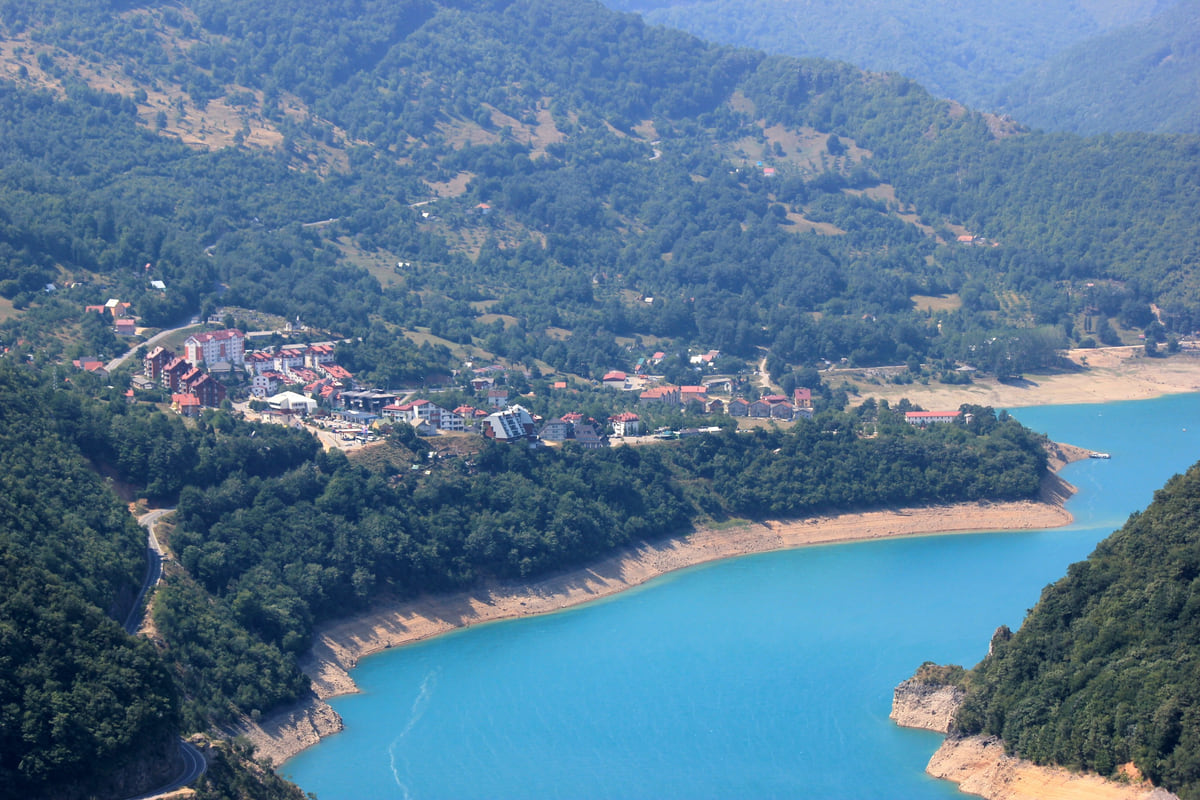
Plužine, the town that moved to the shore of Lake Piva
Plužine is the seat of the municipality of the same name in north-west Montenegro, on the Bosnian border. Today's town was built on the shore of Lake Piva after the hydroelectric dam, completed in 1975, flooded the old one. It had 1,102 residents in 2023 and is the base for Piva Nature Park, the lake and the last stretch of the Tara.
In 30 seconds
Full read: 3 min
- Plužine was rebuilt beside Lake Piva after the 1975 dam drowned the old town.
- It had 1,102 residents in 2023, with 2,177 in the municipality.
- It's the base for Piva Nature Park and 25 km from the Šćepan Polje crossing.
- The Podgorica to Sarajevo road runs through the municipality.
Plužine is a small, quiet town that works well as a base for three things, Lake Piva, the monastery and the rafting take-out at Šćepan Polje. I'd spend a night here if entering or leaving via Bosnia, and use it to try the skorup from the Pišče plateau.

Before you go
What I would keep in mind
-
01 Most beautiful
A new town above the water
The Piva hydroelectric dam, finished in 1975, flooded the old Plužine, then the municipal seat, and the new centre went up beside the reservoir, according to the municipality.
Lake Piva -
02 To save money
The flavours of Pišče
The national tourist board recommends heading up to the Pišče plateau for Piva skorup, prljo cheese, soured milk and grušavina, a drink made from sheep's milk.
-
03 Getting there
The gateway from Bosnia
The Šćepan Polje border crossing is 25 km away and Sarajevo 123 km, according to Piva Nature Park. The Podgorica to Sarajevo road runs through the municipality.
-
04 My tip
The Trsa road up to Durmitor
The road from Plužine to Žabljak via Trsa and the Sedlo saddle is part of the Durmitor ring. The park announces when it reopens after the winter snow.
Durmitor National Park
What I would book
Plužine is one of those places whose story fits into a single picture. The town you stay in isn’t the original. The real one lies at the bottom of Lake Piva, under the water since the hydroelectric dam was completed in 1975. The municipality explains that the new centre was built right beside the reservoir, which is why Plužine now looks out over a turquoise lake ringed by mountains. It’s small, 1,102 people in the town at the 2023 census, but it sits in a corner of the country with plenty to see.
A municipality of mountains and canyons
Plužine municipality covers 853 km² on MONSTAT’s figures and is the country’s seventh largest by area, according to the council. It runs from the Bosnian border to the crests of Durmitor, and its boundaries are almost all natural. The Tara closes it off to the north-east and the Sušica and Komarnica canyons to the east. The highest point is Bobotov Kuk, whose summit carries the boundary with Žabljak, and the lowest is Šćepan Polje, at 433 metres, where the Piva and Tara meet to form the Drina.
It’s also one of the least populated municipalities in Montenegro, with 2,177 people in 2023, and the Pišče plateau, the villages of Trsa and Nedajno and the katuns, the summer herders’ settlements, still shape life in the Piva area.
Lake Piva and the Mratinje dam
The star turn is Lake Piva, 112.5 km² of impounded water on MONSTAT’s figures, which Piva Nature Park describes as 42 km long behind the 220-metre Mratinje dam, one of the tallest in Europe. Building it meant moving Piva Monastery, which was taken down and rebuilt on higher ground with its frescoes. The national tourist board suggests cruises, swimming, fishing, kayaking and a zip line on the lake.
Once your dates are set, check which hotels are still free in Plužine before prices climb.
Piva Nature Park
Much of the municipality is taken up by Piva Nature Park, which runs from the Bosnian frontier to the edge of Durmitor National Park. The park describes itself as the natural link between Durmitor and Bosnia’s Sutjeska National Park, with more than 1,500 plant species, around 2,000 kinds of fungi, bears, wild boar and roe deer in its forests and brown trout, grayling and Danube salmon in the Tara and Piva. It has mountain lakes such as Trnovačko and the Stabna lakes, and around twenty villages with their traditional buildings.
At Goransko, near Plužine, stands the tower of Duke Lazar Sočica, built during the later 1800s. The park says King Nikola nicknamed him Munjica, the lightning bolt, for his speed, and that the geographer Jovan Cvijić called it the tower with the finest view in the Balkans. A 1976 memorial by the sculptor Luka Tomanović commemorates the roughly 520 people, 107 of them children, killed on 7 June 1943 in several Piva villages, according to the park.
Things to do and getting there
From Plužine you can get down to the last stretch of the Tara Canyon. The national tourist board highlights the 18 km rafting run from Brštanovica to Šćepan Polje, and the Šćepan Polje border crossing into Bosnia is 25 km from town. To the east, the Trsa road climbs into Durmitor and joins the scenic ring road, and the park announces each spring when it reopens after the snow.
The Podgorica to Sarajevo road runs through the municipality. Piva Nature Park reckons 109 km to Podgorica, 58 to Nikšić and 123 to Sarajevo, and if you’re driving up from the coast in a hire car, expect slow, winding mountain roads. For food, the national tourist board recommends the Pišče plateau for Piva skorup, prljo cheese and grušavina, and the town for homemade brandy and mead.
If you would rather have a local show you round, book a guided tour in Plužine and choose by the reviews.
Once your dates are set, check which hotels are still free in Plužine before prices climb.
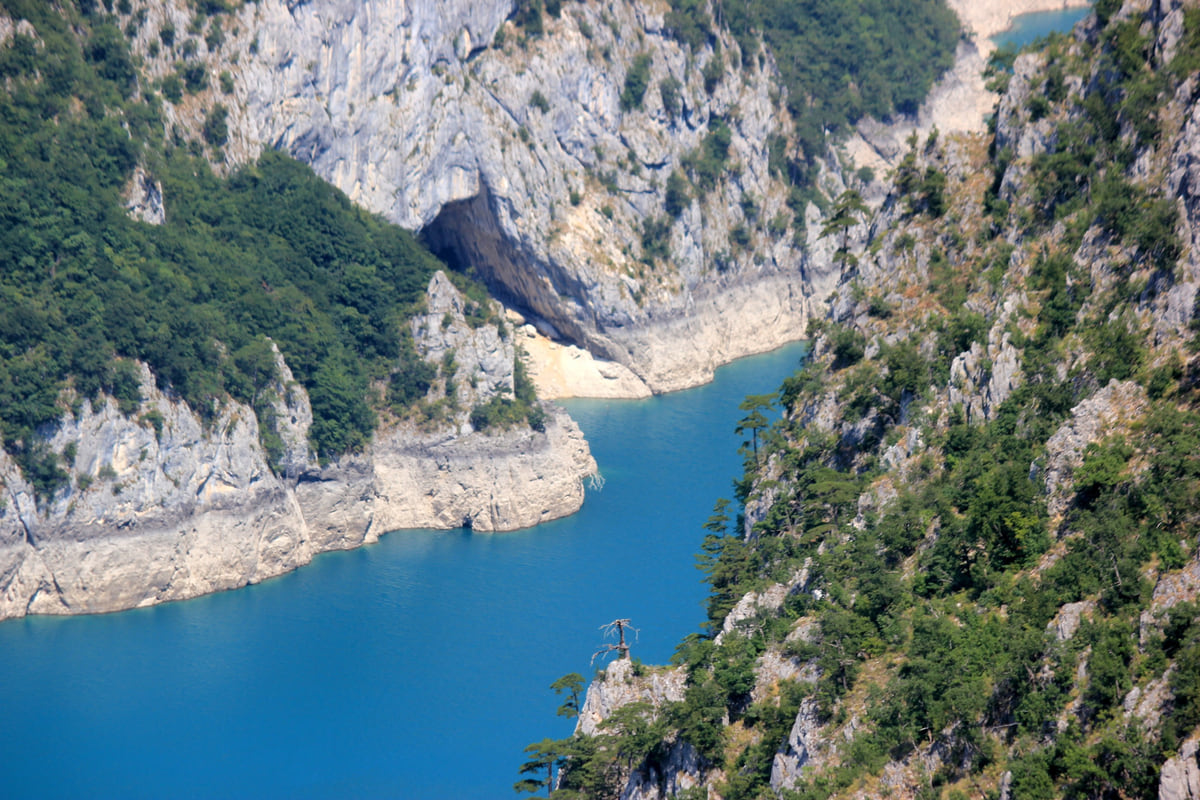
The Piva canyon with the blue water of the reservoir between pale rock walls and forest on the slopes
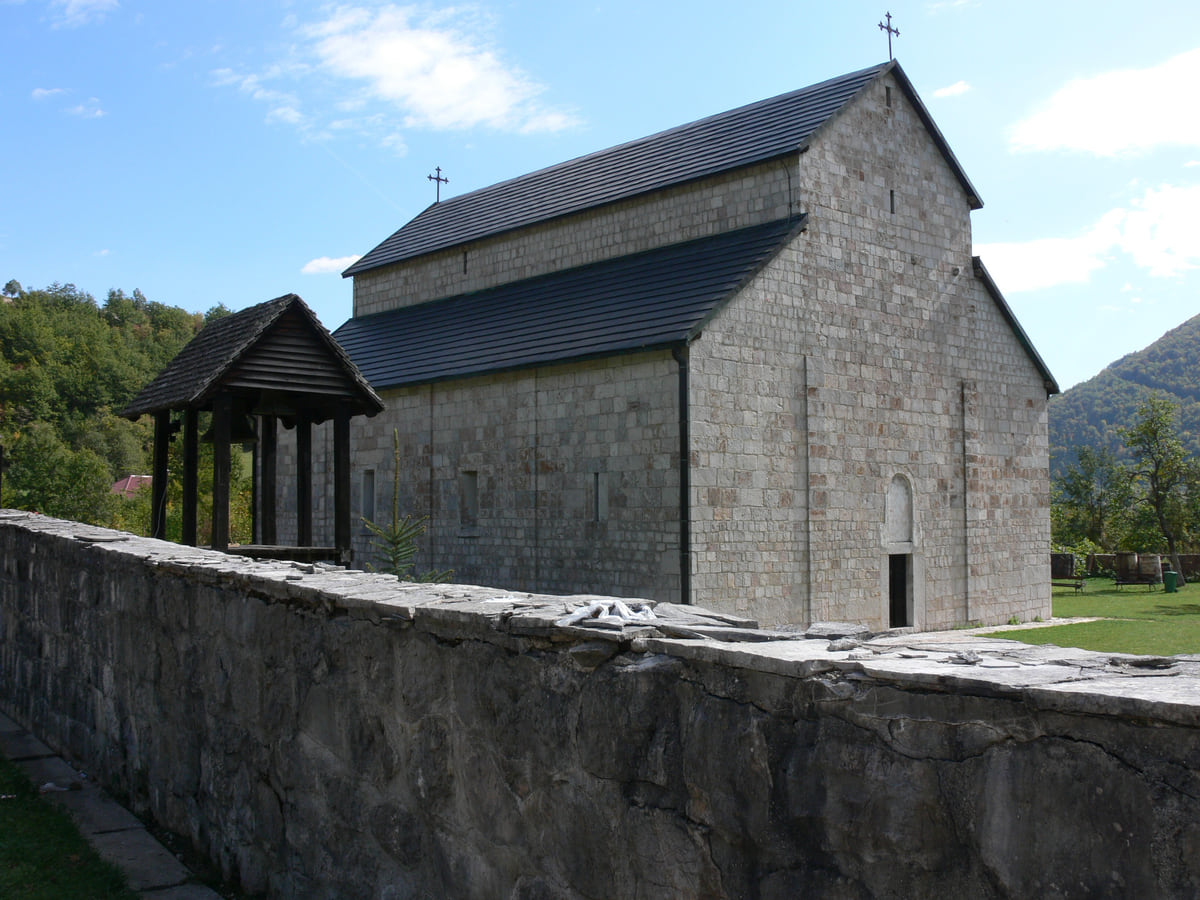
The stone church of Piva Monastery, with a dark pitched roof, behind a wall and beside a small wooden shelter
Distances from Plužine
| Destination | Kilometres |
|---|---|
| Šćepan Polje border crossing | 25 |
| Foča (Bosnia and Herzegovina) | 52 |
| Nikšić | 58 |
| Podgorica | 109 |
| Sarajevo | 123 |
| Dubrovnik | 165 |
Source: Piva Nature Park, getting here, checked on 11 October 2026.
Plužine municipality
| Measure | Value |
|---|---|
| Population (2023) | 2,177 |
| Population (2011) | 3,246 |
| Area | 853 km² |
| Highest point | Bobotov Kuk, on the Žabljak boundary |
| Lowest point | Šćepan Polje, 433 m |
| Arrivals and overnight stays (2024) | 8,805 and 15,470 |
Sources: MONSTAT (2023 census, 2025 yearbook and 2024 tourism) and Plužine municipality.
Test yourself
True or false?
0/3 Pick before you peek.
-
Today's Plužine is the same town as before the dam.
See the answer
False. The old one lies under Lake Piva and the new centre was built beside the reservoir, according to Plužine municipality.
-
The boundary between Plužine and Žabljak runs over Bobotov Kuk.
See the answer
True. Plužine municipality says its boundary with Žabljak crosses Bobotov Kuk, its highest point.
-
Duke Lazar Sočica lived in a tower at Goransko.
See the answer
True. Piva Nature Park says he built it in the second half of the 19th century and that King Nikola nicknamed him Munjica, the lightning bolt.
- Year of the dam that flooded the old town
- 1975
- Municipal area
- 853 km²
- Lowest point, at Šćepan Polje
- 433 m
- Tourist arrivals in 2024
- 8,805
Map
Where Plužine is
The Adriatic coast runs from Herceg Novi to Ulcinj; the centre holds Podgorica, Cetinje and Lake Skadar, and the north, Durmitor and the Tara Canyon. Every number opens its guide.
 1Northern Montenegro 2Žabljak 3Šavnik 4Tara Canyon 5Plužine 6Mojkovac 7Pljevlja 8Kolašin 9Bijelo Polje 10Berane 11Andrijevica 12Petnjica 13Rožaje 14Plav 15Gusinje
 Map data © OpenStreetMap contributors (ODbL)
- 1Northern MontenegroMontenegro's northern region
- 2ŽabljakNorthern Montenegro, Žabljak municipality
- 3ŠavnikNorthern Montenegro, south of Durmitor
- 4Tara CanyonDurmitor National Park, northern Montenegro
- 5PlužineNorthern Montenegro, the Piva area
- 6MojkovacNorthern Montenegro, the Tara valley
- 7PljevljaTown in northern Montenegro
- 8KolašinNorthern Montenegro, Bjelasica
- 9Bijelo PoljeNorthern Montenegro, Lim valley
- 10BeraneNorthern Montenegro, Lim valley
- 11AndrijevicaNorthern Montenegro, upper Lim
- 12PetnjicaNorthern Montenegro, Bihor
- 13RožajeNorthern Montenegro, Ibar valley
- 14PlavNorthern Montenegro, upper Lim
- 15GusinjeNorthern Montenegro, Prokletije
What to see
What to see in Plužine
0 of 278 Montenegro guides
Your next stamp
- Lake Piva
- Piva Monastery
- Lakes
- Monasteries
- Zipline
- Northern Montenegro
- Canyons and waterfalls
- Kolašin
- Aman Sveti Stefan
- Budva Old Town
- Haj-Nehaj
- Kotor
- Lučice Beach
- Montenegro's coast
- Peaks of the Balkans
- Porto Montenegro
- Sea Dance Festival
- Splendid Conference & Spa Resort
- Stari Bar
- Ulcinj Old Town
- Bay of Kotor
- Budva Riviera
- Heroj submarine
- Iberostar Bellevue
- Independence Day
- Old olive tree of Mirovica
- Tivat
- Velika plaža
- Ada Bojana
- Beaches in Budva
- Eurostars Queen of Montenegro
- Herceg Novi
- Kotor Old Town
- Mount Rumija
- Igalo
- Kotor city walls
- Mogren Beach
- Montenegro Beach Resort
- Svač
- Vrmac
- Hiking
- Jaz Beach
- Kanli kula
- Luštica peninsula
- St Tryphon Cathedral
- Ulcinj salt pans
- Forte Mare
- Gornja Lastva
- Maritime Museum, Kotor
- Slovenska Beach
- Drobni Pijesak Beach
- Kotor viewpoints
- Mamula
- Žanjic beach
- Kotor cruise port
- Orjen
- Plavi horizonti beach
- Sveti Nikola Island
- Blue Cave
- Restaurants in Budva
- Restaurants in Kotor
- Canyoning
- Hotels
- Perast
- Sutomore
- Sveti Stefan
- Čanj
- Luxury hotels
- Our Lady of the Rocks
- Pržno
- Things to do
- Activities
- All-inclusive hotels
- Bar Riviera
- Bečići
- Hotel Palma
- St George island
- Dobrota
- Hladna uvala
- Most beautiful places
- Petrovac
- Crvena stijena
- Prčanj
- Prettiest villages
- Cycling
- Risan
- UNESCO sites
- Heritage Grand Perast
- Map
- Hyatt Regency Kotor Bay
- Where is it?
- Regions
- Cities
- Beaches in Bar
- Budva
- Central Montenegro
- Hotels in Budva
- Hotels in Kotor
- Iberostar Waves Herceg Novi
- Kitesurfing
- The name
- Beaches in Ulcinj
- Flag
- Hotels in Perast
- Palmon Bay Hotel & Spa
- Podgorica
- Cathedral of the Resurrection
- One&Only Portonovi
- Population
- Sandy beaches
- Azul Beach Resort Montenegro
- Naturist beaches
- Size
- Stara Varoš
- Doclea
- Language
- Mimosa Festival
- Medun
- Religion
- Currency
- Museums in Podgorica
- Dajbabe Monastery
- EU membership
- History
- Restaurants in Podgorica
- Hotels in Podgorica
- Public holidays
- Avala Resort & Villas
- Bar
- Beaches in Kotor
- Birdwatching
- Hotels in Ulcinj
- Kotor carnival
- Time zone
- Tivat beaches
- Tuzi
- Boka Night
- Dukley Hotel & Resort
- Facts
- Hotels in Tivat
- Zeta
- Caves
- Herceg Novi beaches
- National parks
- Šipčanik
- Hotels in Herceg Novi
- Fortresses
- Fly fishing
- Museums
- Mountains
- Montenegro and Croatia
- Beaches
- Boat trips
- Cetinje
- Montenegro and Albania
- Nightlife
- Ulcinj
- Weather
- Best time to visit
- Cetinje Monastery
- Kayaking
- Montenegro and the Balkans
- How to get there
- In summer
- King Nikola's Palace
- Sailing
- Biljarda
- Flights
- In winter
- Airports
- Museums in Cetinje
- New Year's Eve
- Lovćen
- Paragliding
- Tivat Airport
- Njegoš Mausoleum
- Podgorica Airport
- Dubrovnik to Kotor
- Kotor serpentine
- Belgrade to Montenegro
- Njeguši
- Ferry to Italy
- Njeguši prosciutto
- Border crossings
- In January
- Lipa Cave
- Where to stay
- In February
- Kamenari-Lepetane ferry
- Pavlova strana
- Getting around
- In March
- Rijeka Crnojevića
- In April
- Trains
- Buses
- In May
- Car hire
- In June
- Driving
- In July
- In August
- Taxis
- Distances
- In September
- In October
- Road trip
- Food
- In November
- Lake Skadar
- Scenic drives
- In December
- Kotor cable car
- Virpazar
- Where to eat
- Budva to Kotor
- Godinje
- Wine
- Podgorica to Kotor
- Vranjina
- Besac fortress
- Prices and budget
- On a budget
- Žabljak Crnojevića
- Danilovgrad
- Entry requirements
- Ostrog Monastery
- Tourist registration
- Customs
- Nikšić
- Crvena Stijena cave
- Safety
- Events
- Healthcare
- Mobile and roaming
- Žabljak
- Durmitor
- Plugs
- Black Lake
- With kids
- Bobotov Kuk
- Holidays
- Day trips
- Stećci tombstones
- Hotels in Žabljak
- Three-day itinerary
- Five-day itinerary
- Skiing in Montenegro
- One-week itinerary
- Skiing in Žabljak
- Šavnik
- Ten-day itinerary
- Nevidio Canyon
- Tara Canyon
- Tara rafting
- Đurđevića Tara Bridge
- Mojkovac
- Brskovo
- Pljevlja
- Husein Pasha Mosque
- Hotels in Kolašin
- Skiing in Kolašin
- Biogradska Gora National Park
- Komovi
- Morača Monastery
- Morača Canyon
- Bijelo Polje
- Đalovića Cave
- Berane
- Andrijevica
- Petnjica
- Rožaje
- Plav
- Lake Plav
- Gusinje
- Vusanje
- Prokletije National Park
Frequently asked questions
What is there to do in Plužine?
See Lake Piva and the Mratinje dam, Piva Monastery, Duke Lazar Sočica's tower at Goransko, the Pišče plateau, the Trnovačko and Stabna lakes and, to the north, Šćepan Polje, where the Piva meets the Tara.
Why is Plužine a new town?
Because the old one ended up underwater when the Piva hydroelectric dam was completed in 1975. The new municipal centre was built beside the reservoir, according to Plužine municipality.
How do I get to Plužine?
On the Podgorica to Sarajevo road, which crosses the municipality. It's 109 km from Podgorica and 58 km from Nikšić, according to Piva Nature Park.
What's the weather like in Plužine?
MONSTAT has no weather station in Plužine. The nearest published figures are Nikšić's: in 2024 a July mean of 25.1 °C and a January mean of 4.0 °C. Plužine itself has no published figures.
What is Piva Nature Park?
A protected area in Plužine municipality between the Bosnian border and Durmitor National Park. It links Durmitor with Bosnia's Sutjeska National Park and has more than 1,500 plant species, according to the park itself.
By
Tourism graduate with a master’s in Tourism Management and Planning from the University of Málaga, who has travelled across Europe. He writes every guide from official sources and his own judgement.
Published on . Facts checked on .
Sources
Some links in this guide are affiliate links: if you book through them, the site earns a commission at no extra cost to you. Affiliate disclosure
Photos: Julian Nyča (CC BY-SA 4.0); Julian Nyča (CC BY-SA 4.0); Wiki surfer bcr (Public domain), via Wikimedia Commons.