November is the wettest month
Villefranche-sur-Mer weather by month, using Météo-France's own figures
Villefranche-sur-Mer has no Météo-France station of its own, so I use Nice's, about 10 km away, with 1991-2020 averages. August is the warmest month, with an average high of 27.9°C, and January the coolest, at 13.3°C. Around 791 mm of rain falls a year, almost half of it between September and December, while July sees barely 13 mm.
In 30 seconds
Full read: 3 min
- Villefranche has no Météo-France station; the nearest official one is at Nice.
- August is the warmest month, with a 27.9°C average high, and January the coolest, at 13.3°C.
- November and October are the wettest, each with more than 125 mm.
- July is the driest (13.6 mm) and the sunniest (349 hours).
- June and September are, to my mind, the best months to go.
If I could choose, I'd come to Villefranche in June or September. You get average highs of 24 to 25°C, a warm sea and fewer people than in August. I'd keep October for anyone who doesn't mind a wet day, because it's the rainiest month after November.

Before you go
What I would keep in mind
-
01 Most beautiful
June, the month I'd pick
At Nice, the nearest official station, June averages a 24.7°C high, 3.8 days of rain and nearly 310 hours of sunshine. Proper summer without the heavier heat of July and August.
-
02 My tip
Watch out for the autumn
October averages 127.9 mm and November 138.4 mm at Nice, more than the whole summer put together. If you're coming in autumn, I'd pack an umbrella and an indoor plan.
-
03 To save money
A mild winter to see the village without crowds
The average January high is 13.3°C and frosts are rare. Several hotels close, but the Cocteau chapel and the old town are still there.
things to do in Villefranche-sur-Mer -
04 Getting there
When it rains, the trains keep running
Villefranche station has a train roughly every 15 minutes to Nice and Monaco. A wet day is easily saved with a museum in either.
Nice to Monaco by train, bus or taxi
My priorities
Unmissable
- Check the actual forecast for your dates, because an average won't warn you of a storm
- Pack a warm layer from November to March, with lows of 6 to 10°C
If you have time
- Pick June or September if your dates are flexible
- Swim at Marinières in late summer, when the sea is warmest
I would skip
- Planning nothing but outdoor activities in October or November
- Walking up to the Moyenne Corniche at midday in July or August
What I would book
Looking up the weather for Villefranche-sur-Mer comes with a catch that hardly anyone mentions. Météo-France has no station in the village, and plenty of sites give you figures without saying where they come from. I’d rather go to the official source and tell you which one I’m using. The table above is Nice’s, about 10 km away, with the 1991-2020 averages, and I compare it with Cap Ferrat, which sat just across the bay.
Where do these numbers come from?
The Nice station is at the airport, 2 metres above the sea. Its thirty-year averages are the ones Météo-France publishes on its climate sheet, issued in June 2025. Cap Ferrat, at 138 metres in Saint-Jean-Cap-Ferrat, is closer to Villefranche, but it stopped recording in 2008 and its temperature series runs from 1981 to 2008.
Side by side, they tell you something useful. Winter nights are milder at Cap Ferrat (a 7.8°C January low against 5.8°C at Nice) and it’s slightly drier over the year. Villefranche sits tucked into its bay between Nice and the cape, so I’d treat the Nice table as a cautious estimate and expect slightly gentler nights.
A quick word on reading the table. A rainy day, in Météo-France’s terms, is one with at least 1 mm, so a passing shower counts the same as a downpour. Nice also averages 28 days of thunder a year, and the busiest months for storms run from August to November, which fits the pattern of short, heavy autumn rain.
A long, dry summer
From June to August it barely rains. July is the driest month, averaging 13.6 mm, and the sunniest, with 349 hours of sunshine. August has the highest average high, 27.9°C, and even so the days above 30°C are few, 3.8 on average in August and 3.4 in July. The station record stands at 37.7°C, set on 1 August 2006.
What matters more to me as a traveller isn’t the heat on the thermometer but the heat on the hill. Villefranche’s old town is climbed on foot and the Moyenne Corniche is a long way up, so in July I’d do the climbing first thing and leave the middle of the day for the beaches in Villefranche-sur-Mer.
When does it rain in Villefranche?
In autumn, and quite a lot. September already climbs to 81 mm, October to 127.9 mm and November reaches 138.4 mm, the wettest month of the year. Almost half of the 791 mm annual total falls between September and December. There aren’t many rainy days (7.5 in October and 8.5 in November), but when it rains, it pours. The station’s wettest single day, 191.4 mm, fell on 13 October 1973.
This is where plenty of visitors get caught out. They see an annual average of 16°C and picture a beach holiday in autumn. The average October high is still 21°C, but I wouldn’t build an October or November trip around outdoor plans alone. With trains to Nice and Monaco roughly every 15 minutes, a wet day is rescued by a museum; in the Principality there’s the Oceanographic Museum, and for moving between the two, see the train and bus from Nice to Monaco.
A mild winter, but not T-shirt weather
From December to February average highs hover around 13 to 14°C and lows around 6°C at Nice. Frost is rare, a little over one day a year, and snow the same. It’s a good time to see the old town and the Cocteau chapel in peace, as long as you bear in mind that several hotels close; the ones that stay open are in hotels in Villefranche-sur-Mer.
What about the sea?
Météo-France doesn’t publish water temperatures on its sheets. The nearest official reference I have comes from the SBM, the company behind Monte-Carlo’s casino and grand hotels, for Monaco, a few villages further along the coast. Its range is 24 to 26 degrees at the height of summer, 20 to 23 in early autumn, around 13 in the depths of winter and over 20 already by May. That’s why September strikes me as the most rewarding month for a swim, with the water still warm and an average high of 24.8°C.
If you’re heading on to the Principality, the IMSEE measures the weather at the Exotic Garden there, with its own official figures. They’re in Monaco weather by month.
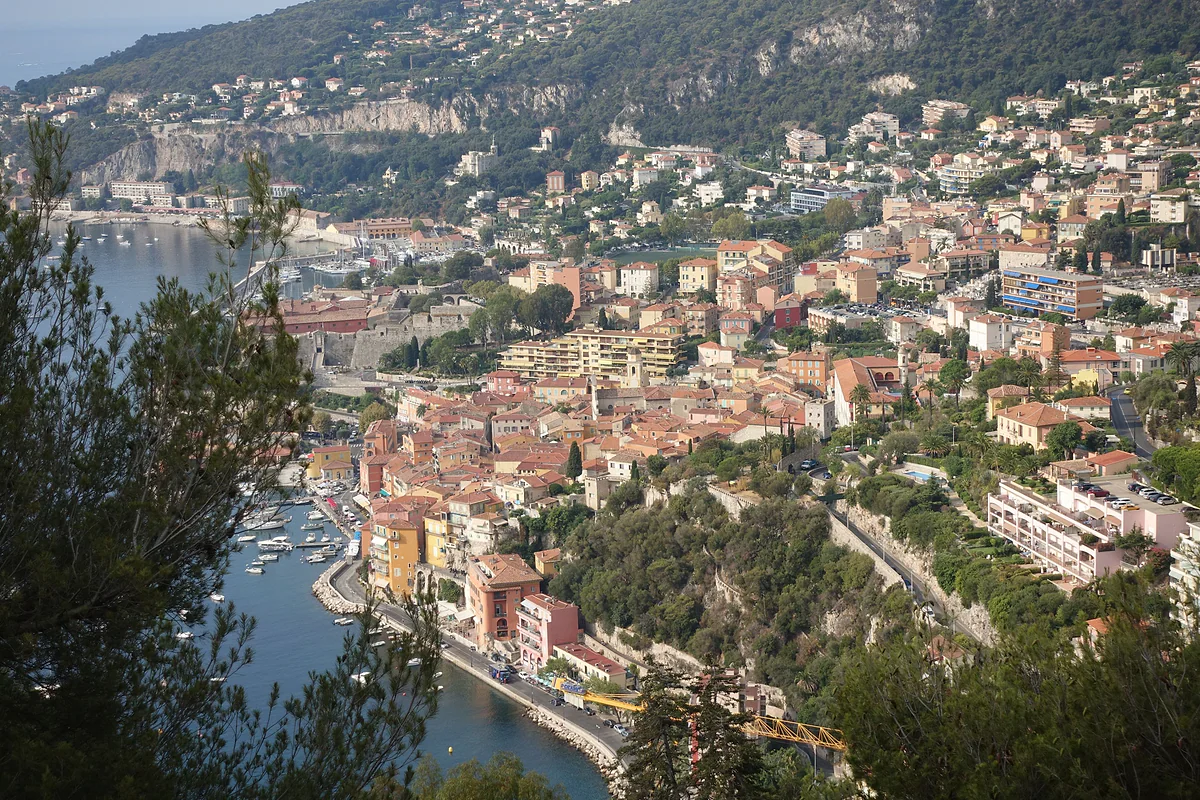
Villefranche-sur-Mer seen from the upper road, with the red-roofed old town beside its bay.
Month by month (Nice, 1991-2020 averages)
| Month | Average high | Average low | Rainfall | Rainy days | Sunshine hours |
|---|---|---|---|---|---|
| January | 13.3°C | 5.8°C | 73.5 mm | 5.8 | 157 |
| February | 13.5°C | 6.1°C | 53.6 mm | 5.1 | 166 |
| March | 15.4°C | 8.3°C | 51.0 mm | 4.9 | 218 |
| April | 17.4°C | 10.8°C | 68.8 mm | 6.4 | 229 |
| May | 21.0°C | 14.5°C | 40.3 mm | 5.1 | 271 |
| June | 24.7°C | 18.1°C | 35.7 mm | 3.8 | 310 |
| July | 27.5°C | 20.8°C | 13.6 mm | 1.8 | 349 |
| August | 27.9°C | 21.1°C | 17.2 mm | 2.3 | 323 |
| September | 24.8°C | 17.7°C | 81.0 mm | 4.9 | 250 |
| October | 21.0°C | 14.0°C | 127.9 mm | 7.5 | 191 |
| November | 17.0°C | 9.7°C | 138.4 mm | 8.5 | 152 |
| December | 14.1°C | 6.6°C | 90.3 mm | 6.0 | 145 |
Météo-France climate sheet for Nice (06088001, airport, 2 m), 1991-2020 averages. Rainy days means days with 1 mm or more. Météo-France has no station in Villefranche.
Cap Ferrat, the station across the bay
| Figure | Cap Ferrat | Nice |
|---|---|---|
| Average August high | 27.3°C | 27.9°C |
| Average January low | 7.8°C | 5.8°C |
| Rain a year | 670.2 mm | 791.3 mm |
| Days of 30°C or more a year | 6.4 | 8.5 |
| Period | 1981-2008 (temperature) | 1991-2020 |
Météo-France sheets 06121001 (Cap Ferrat, 138 m, Saint-Jean-Cap-Ferrat) and 06088001 (Nice). Cap Ferrat stopped recording in 2008.
Test yourself
True or false?
0/4 Pick before you peek.
-
It rains more in Villefranche in August than in November.
See the answer
False. The other way round. At Nice, the nearest official station, August averages 17.2 mm and November 138.4 mm, the wettest month of the year.
-
Météo-France has a weather station in Villefranche-sur-Mer.
See the answer
False. There's no sheet for Villefranche. The nearest are Nice, with 1991-2020 averages, and Cap Ferrat, which stopped recording in 2008.
-
It snows at Nice, on average, just over one day a year.
See the answer
True. Météo-France's sheet gives 1.1 days of snow a year at the Nice airport station, spread across December, January and February.
-
July is the sunniest month on this coast.
See the answer
True. With an average of 349 hours at Nice, July beats August (323) and June (310). It's also the driest, with 13.6 mm.
- Average August high at Nice (1991-2020)
- 27.9°C
- Average annual rainfall at Nice
- 791 mm
- Sunshine hours a year at Nice
- 2,760 h
- Station heat record, 1 August 2006
- 37.7°C
0 of 30 France guides
Your next stamp
- Menton weather
- Villefranche-sur-Mer
- Aparthotel Adagio
- Cap d'Ail coastal path
- Èze Exotic Garden
- Lemon Festival
- Monte-Carlo Beach
- Monte-Carlo Golf Club
- Villefranche beaches
- Cruise port
- Menton beaches
- Nietzsche Path
- Riviera Marriott
- Roquebrune castle
- Roquebrune-Cap-Martin
- Beausoleil
- Getting to Èze
- Monte-Carlo Country Club
- Where to stay in Menton
- Where to stay in Villefranche
- Menton
- Where to stay in Èze
- Cap-d'Ail
- Cocteau museum, Menton
- Èze
- Menton gardens
- La Turbie
- Saint-Jean-Cap-Ferrat
- Beaulieu-sur-Mer
Frequently asked questions
What is the weather like in Villefranche-sur-Mer?
Mild and Mediterranean. Using Météo-France's averages for Nice, the nearest official station, average highs run from 13.3°C in January to 27.9°C in August, with 791 mm of rain a year, mostly in the autumn.
What is the best month to visit Villefranche-sur-Mer?
For me, June or September. Both average around 25°C and the sea has warmed up. July is the driest and sunniest, but also the busiest, while October and November are the wettest.
When does it rain most in Villefranche?
In November, with an average of 138.4 mm at Nice, followed by October with 127.9 mm. Almost half the year's rain falls between September and December.
Is Villefranche cold in winter?
Not very. January averages a high of 13.3°C and a low of 5.8°C at Nice, and at Cap Ferrat, across the bay, the January low rises to 7.8°C. Nice averages about one day of snow a year.
Is the sea warm enough to swim in Villefranche?
Météo-France doesn't publish sea temperatures. As a guide, the Société des Bains de Mer gives Monaco 24 to 26°C in July and August, 20 to 23°C in September and October and around 13°C in winter.
How hot does Villefranche get in August?
The average August high at Nice is 27.9°C, and on average only 3.8 August days go above 30°C. The station's record is 37.7°C, set on 1 August 2006.
By
Tourism graduate with a master’s in Tourism Management and Planning from the University of Málaga, who has travelled across Europe. He writes every guide from official sources and his own judgement.
Published on . Facts checked on .
Sources
Photos: Bengt Nyman (CC BY 3.0); Joseolgon (CC BY-SA 4.0), via Wikimedia Commons.